
 Shop Vielight tech











Nature Scientific Reports: Light Penetration Study of 3 Brain PBM Devices (Skull/Skin/Fluids)
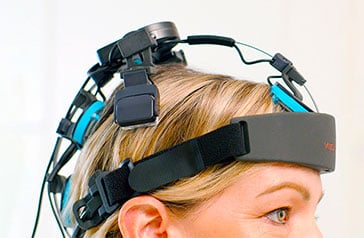
Consumer brain photobiomodulation (PBM) devices often market external output specs, like total power, number of LEDs, or specific near-infrared wavelengths such as 810nm and 1070nm. However, these numbers ignore the most critical factor: how much light actually penetrates the scalp, skull, and cerebrospinal fluid to reach the brain.
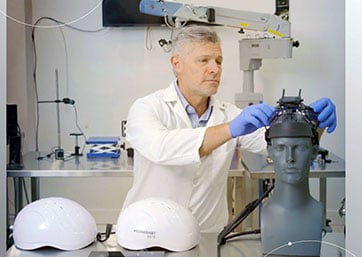
A new study in Scientific Reports, a Nature Portfolio journal, conducted by researchers at the University of Illinois Chicago measured how much NIR energy three commercial brain PBM devices actually deliver behind a human skull.
Enam S, Saint-Martin L, Manwar R, Avanaki K. Micro-CT-informed Monte Carlo and experimental dosimetry of transcranial photobiomodulation devices. Scientific Reports, 2026, in press. doi.org/10.1038/s41598-026-75995-y

6 key takeaways from the paper
The paper’s central finding is that a brain light therapy devices’ architecture and power, more than its wavelength or LED count, decide how much light actually reaches the brain. This post walks through each takeaway with the supporting data.
Neuro Pro 2 delivered the most light through the skull
~4-7 times more than the Neuronic Light over the front and right side of the head.
Neuro Pro 2 delivered the most light through brain tissue
~5-13 times more than either helmet.
810nm delivered more light than 1070nm
In computer models that gave every wavelength the same light source, 1070nm passed through bone best. When the researchers measured the real devices, the opposite was found to be true: the 810nm Neuro Pro 2 delivered more light than both 1070nm helmets.
Architecture beats LED count
Helmets with 256 and 300 LEDs delivered less than the Pro 2’s 12 high-output emitters.
The intranasal route offers a unique way into the brain
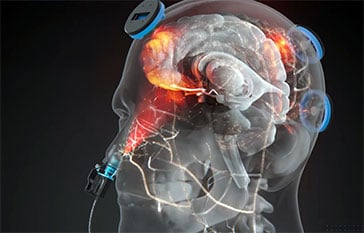
The Pro 2 was the only device tested with this second route into the brain.
What to ask before you buy
How much light reaches the brain after the skull. The authors argue every device comparison should report this measured number.
About the study
The study comes from Dr. Kamran Avanaki’s bioengineering lab at the University of Illinois Chicago, with a co-author from Sam Houston State University. Each device (Vielight Neuro Pro 2, Neuronic Light and Neuronic Neuradiant) emitted NIR light through:
- pig skin
- human skull calvaria
- gel mimicking the fluid around the brain (CSF)
A calibrated spectrometer measured what came out the other side at 12 sites across four regions of the head. The Neuro Pro 2 was set to 100% irradiance, the same irradiance as the Vielight Neuro 4.
The team also measured light through sheep brain tissue, mapped an intranasal light path, and ran computer models of light travel through two micro-CT-scanned human skulls at 23 wavelengths.
| Paper | Micro-CT-informed Monte Carlo and experimental dosimetry of transcranial photobiomodulation devices |
|---|---|
| Journal | Scientific Reports (Nature Portfolio), published online October 25, 2026 |
| Authors | Enam S, Saint-Martin L, Manwar R, Avanaki K |
| Institutions | University of Illinois Chicago (Avanaki lab); Sam Houston State University |
| Devices tested | Vielight Neuro Pro 2 (810nm), Neuronic Neuradiant (1070nm), Neuronic Light (1070nm) |
| Neuro Pro 2 setting | 100% irradiance, the same irradiance as the Vielight Neuro 4 |
| Tissues | Pig skin, human skull calvaria and CSF-mimicking gel; sheep brain tissue in a separate test |
| Measurement | Calibrated spectrometer at 12 sites across four head regions: frontal, left parietal, right parietal and occipital |
| Computer modelling | Monte Carlo simulations of two micro-CT-scanned human skulls at 23 wavelengths |
| Funding | Partially funded by Vielight Inc.; the UIC team was responsible for design, data collection and analysis |
| Scope | Light delivery through tissue models; the study did not measure outcomes in people |
1. The Neuro Pro 2 delivered the most transcranial NIR light
Behind the skull, the Neuro Pro 2 delivered 0.92 mW/cm² in the right parietal region and 0.53 mW/cm² frontally, against ~0.14 mW/cm² for the Neuronic Light in those same regions. That is ~4-7 times more light over the front and right side of the head. Over the back of the head (occipital), all three devices delivered similarly low levels, between ~0.10 and ~0.14 mW/cm².
Light intensity behind the skull, by region
How much light from each device made it through skin, skull and the fluid around the brain, in four areas of the head (mW/cm²)

Frontal
0.53 mW/cm²
~0.15 mW/cm²
~0.14 mW/cm²

Left parietal
~0.47 mW/cm²
~0.14 mW/cm²
0.19 mW/cm²

Right parietal
0.92 mW/cm²
~0.14 mW/cm²
~0.14 mW/cm²

Occipital
0.13 mW/cm²
~0.10 mW/cm²
~0.14 mW/cm²
View the data as a table
| Head region | Neuro Pro 2 (810nm) | Neuronic Neuradiant (1070nm) | Neuronic Light (1070nm) |
|---|---|---|---|
| Frontal | 0.53 | ~0.15 | ~0.14 |
| Left parietal | ~0.47 | ~0.14 | 0.19 |
| Right parietal | 0.92 | ~0.14 | ~0.14 |
| Occipital | 0.13 | ~0.10 | ~0.14 |
Source: Enam S, Saint-Martin L, Manwar R, Avanaki K. Scientific Reports, 2026, in press. Study partially funded by Vielight Inc.
Here is the same data drawn as head maps on one colour scale. Blue means little light got through the skull; green, yellow and red mean progressively more.

You can see a similar pattern on camera. In the video below, we shone the Vielight Neuro Pro 2 (810nm) and a 1070nm Neuronic helmet through a real adult human skull, with no skin or CSF layer, and filmed the far side with a camera that has little to no infrared filtering. Near-infrared light is invisible to the eye, so the camera shows how much light from each brain light therapy device made it through the bone.
Qualitative test, not a measurement. Light passes through a real adult human skull only, without the skin and CSF layers used in the UIC study. The helmet was set to its maximum intensity. Camera sensors respond differently to 810nm and 1070nm light, so on-screen brightness is not a direct measure of delivered light; the measured values are in the chart above. Watch on YouTube
2. It also delivered the most light through brain tissue
In a separate test that shone light straight into sheep brain tissue, with no skull in the way, the Pro 2 delivered ~5-13 times more light than either helmet.
Light remaining after brain tissue
A test on how much light passes through sheep brain tissue from one LED of each device (mW/cm²)

1 cm
3.05 mW/cm²
~0.34 mW/cm²
~0.24 mW/cm²

2 cm
2.58 mW/cm²
~0.21 mW/cm²
~0.20 mW/cm²

3 cm
1.01 mW/cm²
~0.17 mW/cm²
~0.22 mW/cm²
View the data as a table
| Tissue depth | Neuro Pro 2 (810nm) | Neuronic Neuradiant (1070nm) | Neuronic Light (1070nm) |
|---|---|---|---|
| 1 cm | 3.05 | ~0.34 | ~0.24 |
| 2 cm | 2.58 | ~0.21 | ~0.20 |
| 3 cm | 1.01 | ~0.17 | ~0.22 |
Source: Enam S, Saint-Martin L, Manwar R, Avanaki K. Scientific Reports, 2026, in press. Study partially funded by Vielight Inc.
3. Longer wavelength did not win: 810nm vs 1070nm
In computer models where every wavelength got an identical light source, 1064 to 1070nm passed through bone best, because longer wavelengths scatter less. In practice, the opposite was true: when the researchers measured the real devices, the 810nm Neuro Pro 2 delivered more light through the skull than both 1070nm helmets. Getting light through the skull is only half the story.
To have an effect, the light has to be absorbed, and the main target in brain photobiomodulation research is cytochrome c oxidase, a light-absorbing enzyme inside mitochondria. The paper’s wavelength chart shows mitochondria absorbs light most strongly near 810nm and far less at 1064 to 1070nm.
At 1064 to 1070nm, the main mechanism shifts from mitochondria to calcium ion channels, which need a much higher irradiance to produce a photobiological effect.

The authors describe the difference between their simulation, which favoured 1070nm, and the real devices, where the 810nm Pro 2 delivered the most light, as “informative rather than contradictory.”
In other words, wavelength affects how light travels through tissue, but a device’s design and power decide how much light actually arrives.
A closer look
Why wavelength matters inside the cell
810nm is more strongly absorbed by cytochrome c oxidase (CCO), the mitochondrial enzyme at the center of brain photobiomodulation. Past 980nm, CCO absorption drops rapidly, and longer wavelengths shift the response away from the mitochondria and toward calcium ion channels.
The 1064nm brain studies that reported effects also used far more intense light than the helmets in this study provide: a laser at 250 mW/cm² at the scalp. The Neuronic Neuradiant’s LEDs are rated at 1.31 mW/cm², under 1% of that level. The Neuronic Light mixes 291 standard LEDs at 1.53 mW/cm² with 9 higher-power LEDs at 97.08 mW/cm², still well under half.
Sources: Wang et al., 2017; Saucedo et al., 2021; Enam et al., 2026. Full references below.
For the wider evidence on wavelength, see our guide to 810nm vs 1070nm for brain photobiomodulation.
4. Device architecture outweighed LED count
Skin, skull and CSF stopped more than 96% of every device’s light, so the amount a brain light therapy device starts with decides what arrives. That is the problem the Pro 2 is built to solve. It concentrates its output in 12 high-output emitters, while the helmets spread far less power across hundreds of small LEDs, and the difference showed up at every stage of the study.
The authors put this at the center of their findings: wavelength determines how light interacts with tissue, but a device’s architecture and emitted power determine how much usable light actually arrives. They point to how well each device’s light sources couple to the head as one of the reasons the real devices did not follow the computer models.
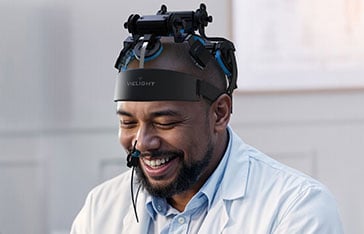
This is why we built the Neuro around individual modules rather than a rigid shell. Light weakens quickly as it travels and scatters before it reaches the skin, so any gap between a light source and the scalp costs intensity before the light even meets the skull. A rigid helmet has one fixed shape, while heads vary. Independent Vie-LED modules sit against the scalp wherever they are placed, and their high output means more light is left after the skull takes its share.

Light at the source
How much light each brain light therapy manufacturer says its device puts out
Light intensity at the device (mW/cm²)
up to 400 mW/cm²
1.31 mW/cm²
97.08 mW/cm² (9 LEDs)
Total light output (mW)
up to 12,000 mW
646 mW
1,726 mW
The Neuronic Light lists 9 high-power LEDs at 97.08 mW/cm². Source: Enam S, Saint-Martin L, Manwar R, Avanaki K. Scientific Reports, 2026, in press. Study partially funded by Vielight Inc.
| Vielight Neuro Pro 2 | Neuronic Neuradiant | Neuronic Light | |
|---|---|---|---|
| Wavelength | 810nm | 1070nm | 1070nm |
| Form factor | Modular headset with intranasal applicator | Rigid helmet | Rigid helmet |
| Light sources | 12 high-output Vie-LED modules | 256 LEDs | 300 LEDs (291 standard, 9 high-power) |
| Rated intensity at the device | Up to 400 mW/cm² | 1.31 mW/cm² | 1.53 mW/cm² (291 LEDs); 97.08 mW/cm² (9 LEDs) |
| Total light output | Up to 12,000 mW | 646 mW | 1,726 mW |
| Intranasal route | Yes | No | No |
| Setting in this study | 100% irradiance, the same irradiance as the Vielight Neuro 4 | – | – |
| Measured behind the skull, highest region | 0.92 mW/cm² (right parietal) | ~0.15 mW/cm² (frontal) | 0.19 mW/cm² (left parietal) |
| Share of light through skin, skull and CSF | 1.31% to 3.93% | 0.65% to 1.73% | 0.70% to 2.81% |
| Measured after 1 cm of brain tissue (one LED) | 3.05 mW/cm² | ~0.34 mW/cm² | ~0.24 mW/cm² |
| Session length the authors assumed for fluence | 3 minutes | 10 minutes | 10 minutes |
Source: Enam S, Saint-Martin L, Manwar R, Avanaki K. Scientific Reports, 2026, in press. Study partially funded by Vielight Inc.
A helmet lined with LEDs looks like even coverage, but the skull does not pass light evenly. Its thickness and its spongy, blood-rich middle layer vary from region to region, and the lab found bone broke an even beam into an uneven patchwork. The authors conclude that an even layout outside the head does not produce an even field inside it. Hundreds of LEDs did not close the gap: the Pro 2’s 12 emitters out-delivered both helmets behind the skull and through brain tissue.
Share of light that passed through skin, skull and CSF
What percentage of each device’s light made it through skin, skull and the fluid around the brain
Frontal
2.55%
0.78%
2.52%
Left parietal
2.53%
1.60%
2.81%
Right parietal
3.93%
1.73%
2.45%
Occipital
1.31%
0.65%
0.70%
View the data as a table
| Head region | Neuro Pro 2 (810nm) | Neuronic Neuradiant (1070nm) | Neuronic Light (1070nm) |
|---|---|---|---|
| Frontal | 2.55% | 0.78% | 2.52% |
| Left parietal | 2.53% | 1.60% | 2.81% |
| Right parietal | 3.93% | 1.73% | 2.45% |
| Occipital | 1.31% | 0.65% | 0.70% |
Source: Enam S, Saint-Martin L, Manwar R, Avanaki K. Scientific Reports, 2026, in press. Study partially funded by Vielight Inc.
Before the skull: the hair problem
The UIC team shone each device through hairless pig skin, a human skull and CSF gel, so every result above is a best case. On many real heads, especially women’s, light has to get past hair before it reaches the scalp at all.
Hair is very good at stopping light. Its pigment absorbs light and its strands scatter it, and thick, dark hair blocks the most. Hair can absorb up to 99% of a device’s light energy before any of it touches the skin. Whatever gets through then loses up to 98% more to skin, skull and CSF.
How much LED light makes it to the brain
Light energy left at each layer when a device shines through hair, at the upper end of absorption
Hair absorbs up to 99% of the light energy
Modular design
Parts the hair so light reaches the scalp
Rigid helmet shape
Cannot part hair, so light has to pass through it
Skin, skull and CSF absorb up to 98% of what is left
Modular design
Maximum contact with the scalp at sufficient irradiance
Rigid helmet shape
One fixed shape, so it cannot keep full contact with every head
Bars are to scale; the two smallest are widened slightly so they stay visible. 0.02% combines both upper limits (1% left after hair × 2% left after skin, skull and CSF). Skin, skull and CSF figure: Enam et al., Scientific Reports, 2026, which found these layers absorbed more than 96% of every device’s light.
This makes device form factor extremely important.
- A rigid helmet shape sits on top of the hair, so the hair absorbs the most light before any reaches the scalp.
- The Neuro’s Vie-LED modules are separate pieces with concave lenses that can part the hair and rest closer to the scalp, then deliver their full output from there.
5. The intranasal route bypasses the skull
The Pro 2 was the only brain light therapy device in the study with an intranasal applicator, which sends light through the nasal cavity rather than through the skull. In the authors’ intranasal test, delivery depended on placement and path rather than bone, and they describe it as a complementary route to anterior and olfactory-adjacent areas. Separate research from Baycrest (Motsenyat et al., 2025) found intranasal light changed cerebrospinal fluid flow about as much as forehead light, at roughly one twentieth of the power.
6. What to ask before you buy: light measured after the skull
The authors close the paper with a clear recommendation: compare devices on the light measured after the skull, not on the spec sheet. These are the three numbers the study uses, and the ones worth asking any brand for.
| Measure | What it tells you | Unit |
|---|---|---|
| Transmittance | The share of a device’s light that gets through the tissue | % |
| Irradiance | How intense the light is when it arrives | mW/cm² |
| Fluence | The energy that builds up over a session | J/cm² |
The only measure on which the helmets drew level was total dose (fluence), and only because the authors assumed a 10-minute helmet session against a 3-minute Pro 2 session. The paper’s own device table lists default sessions of 10 to 20 minutes for all three devices. Since fluence is intensity multiplied by time, at equal session lengths the Pro 2’s higher intensity delivers several times the dose. They also stress that equal fluence does not mean an equal biological response, because how intensely light is delivered matters too. Their recommendation is that every device comparison report measured light after the skull, and we agree.
A closer look
Why light intensity matters, not just total dose
There is a strong biological argument that higher-intensity light is more effective for neurons, particularly to actively boost metabolism rather than simply maintain survival.
1. Reciprocity failure and activation thresholds. In neuron-like cells, short exposures at higher intensity triggered stronger metabolic responses than long exposures at lower intensity, even with the same total energy. This points to a critical threshold that must be crossed to efficiently activate cytochrome c oxidase.
2. Functional enhancement vs. simple protection. Very low intensities over long periods mainly help neurons survive, acting as a slow protective shield. Rapid gains, such as more ATP, higher mitochondrial membrane potential and neurite growth, have typically relied on higher intensities.
3. The advantage of pulsed peak power. At a 10% duty cycle, an average of 0.5 mW/cm² strikes cells as peaks of 5 mW/cm². At the same average, higher peaks produced greater ATP production, higher mitochondrial membrane potential and stronger ROS signaling. The Neuro Pro 2 pulses at 1 to 10,000 Hz.

In short, very low intensity can gently protect neurons, but higher intensity provides the photon flux needed to actively upregulate mitochondrial output.
Sources: Lanzafame et al., 2007; Tang et al., 2023. Full references below.
Look beyond the claims
Wavelength and LED count are claims about the device, not measurements of what reaches the brain. Ask how much light a device delivers after the skull, how long a session runs, and whether light reaches the brain by more than one route.
In this study the Neuro Pro 2 outperformed both 1070nm helmets on light intensity behind the skull and through brain tissue. It pairs 12 high-output 810nm modules that sit against the scalp with an intranasal applicator, a second route into the brain that does not depend on getting through the skull.
What is brain light therapy (transcranial photobiomodulation)?
Transcranial photobiomodulation (tPBM) uses red or near-infrared light, delivered through the scalp and skull, with the aim of supporting how brain cells produce energy. Devices include 810nm headsets such as the Vielight Neuro Pro 2 and 1070nm helmets, often marketed as red light therapy helmets. Intranasal-transcranial photobiomodulation (itPBM), the approach Vielight specializes in, adds light delivered through the nasal cavity.
How does the Vielight Neuro Pro 2 compare with other helmets?
Four key things set the Neuro Pro 2 apart:
- Research: it is built on Vielight’s intranasal-transcranial (itPBM) platform, the approach behind 25+ published studies.
- Vie-LED modules: 12 independently programmable, high-output modules, the emitters that delivered the most light in this study.
- Intranasal applicator: a second route into the brain that helmets do not have.
- Customizable protocols: pulse rates from 1 to 10,000 Hz, set through the Neuro Pro App.
For a full breakdown of how Vielight technology compares with PBM helmets, see our guide to itPBM vs PBM helmets.
Do 1070nm helmets deliver more light through the skull than 810nm?
No. In this study the 810nm Vielight Neuro Pro 2 delivered more light through the skull than both 1070nm helmets, the Neuronic Neuradiant and the Neuronic Light. Computer models favoured 1070nm only when every wavelength had an identical light source.
Does hair block brain light therapy?
Yes. Hair can absorb up to 99% of a device’s light before it reaches the scalp, and thick, dark hair blocks the most. The UIC study used hairless skin samples, so its results are a best case. Devices whose light sources can part the hair and sit directly on the scalp lose far less.
How much light gets through the skull?
In this study, between 0.65% and 3.93% depending on the device and the region. Because the share is small for every device, the amount a device starts with decides how much arrives.
Why does device architecture matter for brain light therapy?
Because the skull blocks most light, how a device delivers its light decides what arrives. In this study, a device’s architecture and emitted power predicted delivered light better than its wavelength or LED count. Light sources that sit close against the scalp lose less intensity before reaching the skull, and higher-output sources leave more light after it.
Is more light always better for brain photobiomodulation?
No. Photobiomodulation has a biphasic dose response, so too little light does little and too much can reduce the effect. For the brain, the authors note the skull and tissue remove so much light that the practical risk at depth is delivering too little.
Who funded the study?
Vielight Inc. partially funded it. The University of Illinois Chicago authors are listed as responsible for its design, data and analysis. The study measured light delivery through tissue models, not outcomes in people.
References
Enam S, Saint-Martin L, Manwar R, Avanaki K. Micro-CT-informed Monte Carlo and experimental dosimetry of transcranial photobiomodulation devices. Scientific Reports, 2026, in press. doi.org/10.1038/s41598-026-75995-y
Motsenyat A, Zhong X, Van Lankveld H, Chen JX, Chen JJ. Modulating cerebrospinal fluid dynamics using pulsed photobiomodulation. Brain Stimulation, 2025. doi.org/10.1016/j.brs.2025.102988
Lanzafame RJ, Stadler I, Kurtz AF, Connelly R, Peter TA Sr, Brondon P, Olson D. Reciprocity of exposure time and irradiance on energy density during photoradiation on wound healing in a murine pressure ulcer model. Lasers in Surgery and Medicine, 2007. doi.org/10.1002/lsm.20515
Saucedo CL, Courtois EC, Wade ZS, Kelley MN, Kheradbin N, Barrett DW, Gonzalez-Lima F. Transcranial laser stimulation: mitochondrial and cerebrovascular effects in younger and older healthy adults. Brain Stimulation, 2021. doi.org/10.1016/j.brs.2021.02.011
Tang L, Qin H, Lin S, Liu M. Effects of pulsed red and near-infrared light on neuroblastoma cells: pilot study on frequency and duty cycle. Photonics, 2023. doi.org/10.3390/photonics10030315
Wang Y, Huang YY, Wang Y, Lyu P, Hamblin MR. Photobiomodulation of human adipose-derived stem cells using 810 nm and 980 nm lasers operates via different mechanisms of action. Biochimica et Biophysica Acta, 2017. doi.org/10.1016/j.bbagen.2016.10.008
General wellness device. Not intended to diagnose, treat, or cure any disease.


