
 Shop Vielight tech














Analytical Problem-Solving Ability Clinical Trial | Double-Blind, Sham-Controlled | 56 Participants
In a randomized, double-blind, sham-controlled trial with 56 healthy adults at Spain’s University of Deusto, participants using the Vielight Neuro Gamma solved about 18% more word-association problems than the sham group and scored higher on the Stroop test of attention control. Both results came during a single 20-minute session.
Research summary of Peña et al. (2026), The Journal of Creative Behavior, 60(2), e70112. Read full study here.
Vielight devices are general wellness products. They are not intended to diagnose, treat, cure, or prevent any disease, including TBI, concussion, or CTE. This article summarizes published research for educational purposes.
Key findings
| Problem-solving | The Neuro Gamma group averaged 10.31 correct answers on the Remote Associates Test versus 8.72 for sham, after adjusting for baseline (p = 0.020). That is about 1.6 more correct answers, a moderate effect. |
| Attention control | The Neuro Gamma group scored 8.95 on Stroop interference versus 5.58 for sham (p = 0.031). Higher scores mean stronger inhibitory control. |
| Speed of effect | Both differences appeared during one 20-minute session, with tests taken while the device was on. |
Why this study carries weight
The trial was run by an independent university team, funded by public research grants, and published in a peer-reviewed Wiley journal. Both the participants and the researchers running the sessions were blinded. The sham headset looked identical to the real one and switched itself off three seconds after touching the scalp. Group sizes came from a formal power calculation, the two groups were matched at baseline on age, sex, education and handedness, and the authors declared no conflicts of interest.
The study also breaks new ground. According to the authors, it is only the second study to use transcranial photobiomodulation (tPBM) to enhance creative thinking, after their own earlier work, and the first to test Stroop performance during tPBM over both sides of the dorsolateral prefrontal cortex (DLPFC). The author team includes Roger E. Beaty of Pennsylvania State University, whose research on the brain networks behind creativity is cited throughout the paper.
Study design
| Design | Randomized, double-blind, sham-controlled, parallel groups, single session |
| Participants | 56 healthy adult volunteers, native Spanish speakers, 28 per group, average age about 28 |
| Device | Vielight Neuro Gamma, using 2 of its 4 transcranial LEDs |
| Placement | Left and right DLPFC (positions F3 and F4 on the EEG 10-20 system) |
| Light | 810 nm near-infrared, pulsed at 40 Hz, 50% duty cycle, 100 mW/cm² per LED |
| Session | 20 minutes; tests taken at baseline and again during stimulation |
| Sham | Physically identical headset that switches off 3 seconds after scalp contact |
| Blinding check | Participants could not reliably tell real from sham |
| Ethics | Approved by the University of Deusto Research Ethics Committee |
| Funding | Basque Government Department of Education and Science; Spanish Ministry of Science, Innovation and Universities. No conflicts of interest declared. |
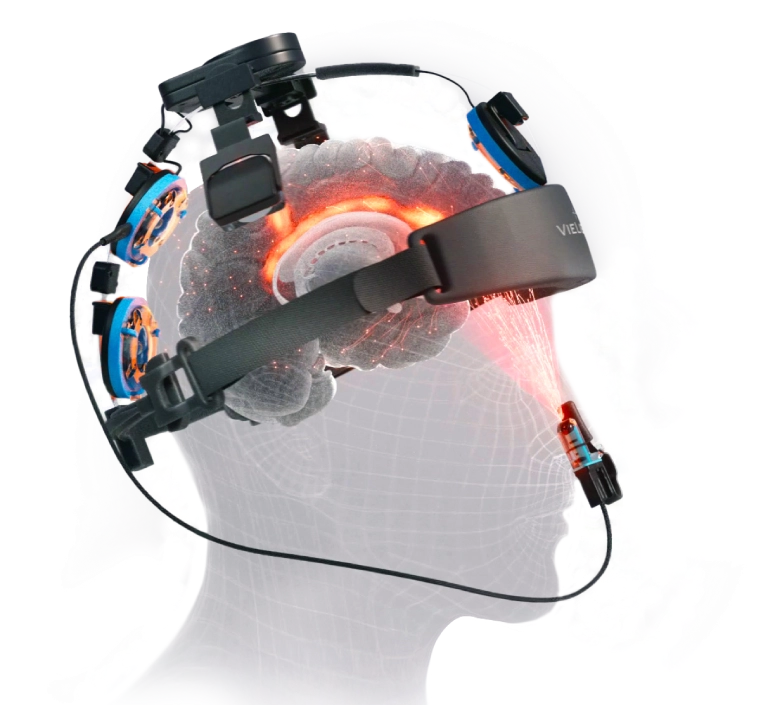
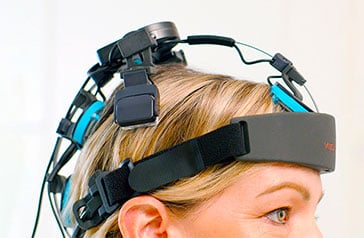
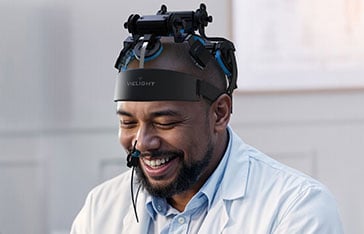
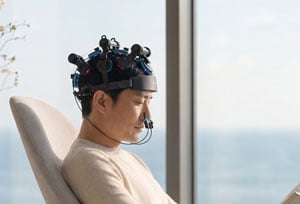
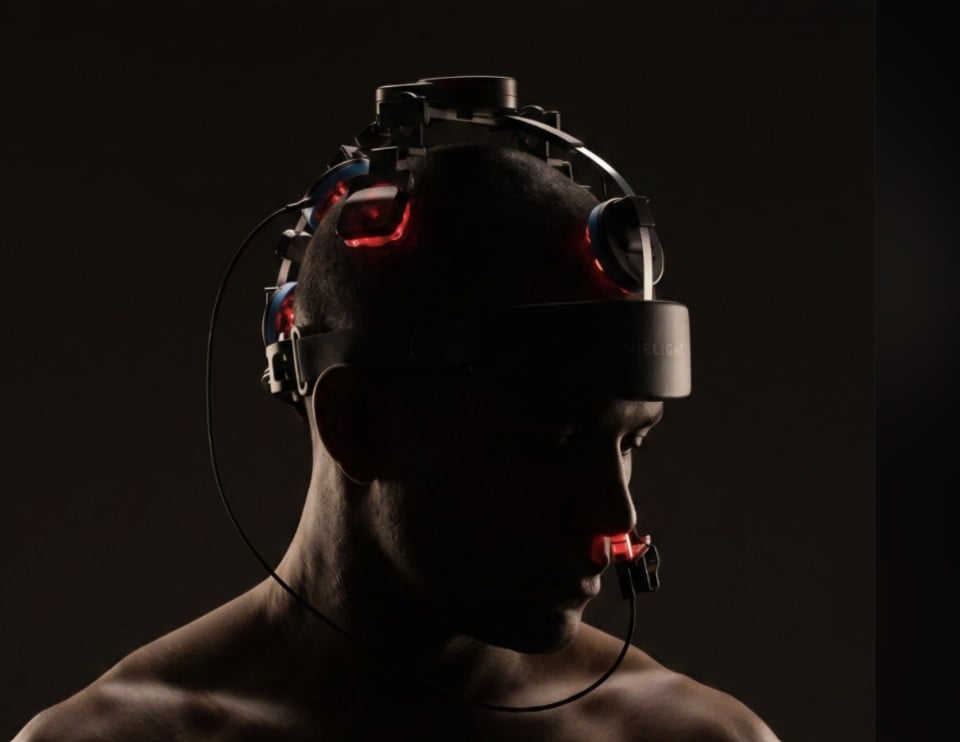
The Vielight Neuro Gamma. The study used two of its four transcranial LEDs, placed over the left and right DLPFC.
What the tests measure
Convergent thinking is the ability to take scattered clues and narrow them to the one answer that fits. The Remote Associates Test (RAT) measures it with words: find the single word linked to three cue words. Its picture-based version, the Language-Independent RAT (LI-RAT), does the same with images. Divergent thinking, the ability to generate many ideas, was measured with Unusual Uses (words) and Picture Completion (drawings).
The Stroop test measures inhibitory control. Naming the ink color of the word “RED” printed in blue requires overriding the automatic urge to read the word.
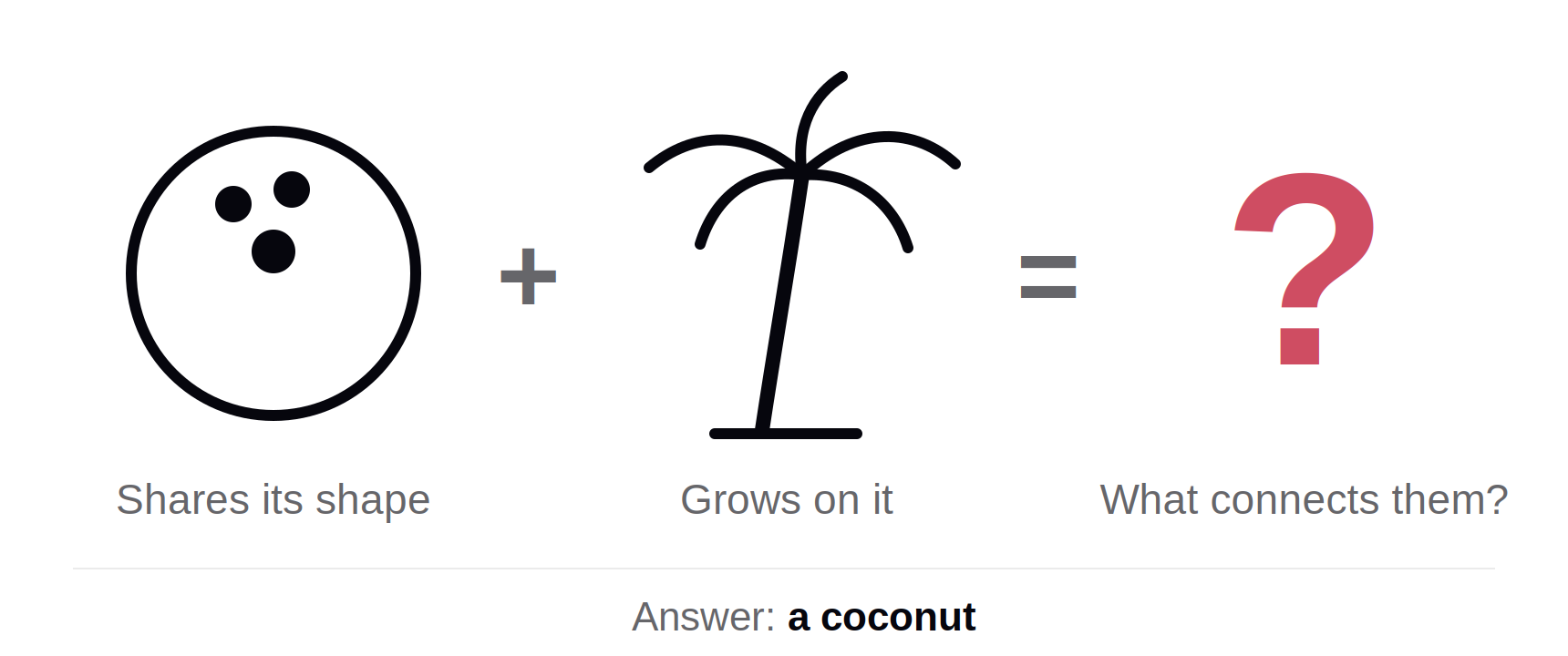
An example LI-RAT item described in the study: a bowling ball and a palm tree both link to a coconut, one by shape and one by meaning.
Results
After adjusting for each person’s baseline score, the Neuro Gamma group outperformed sham on verbal convergent thinking and on the Stroop test. The authors rate the RAT effect as moderate in size.
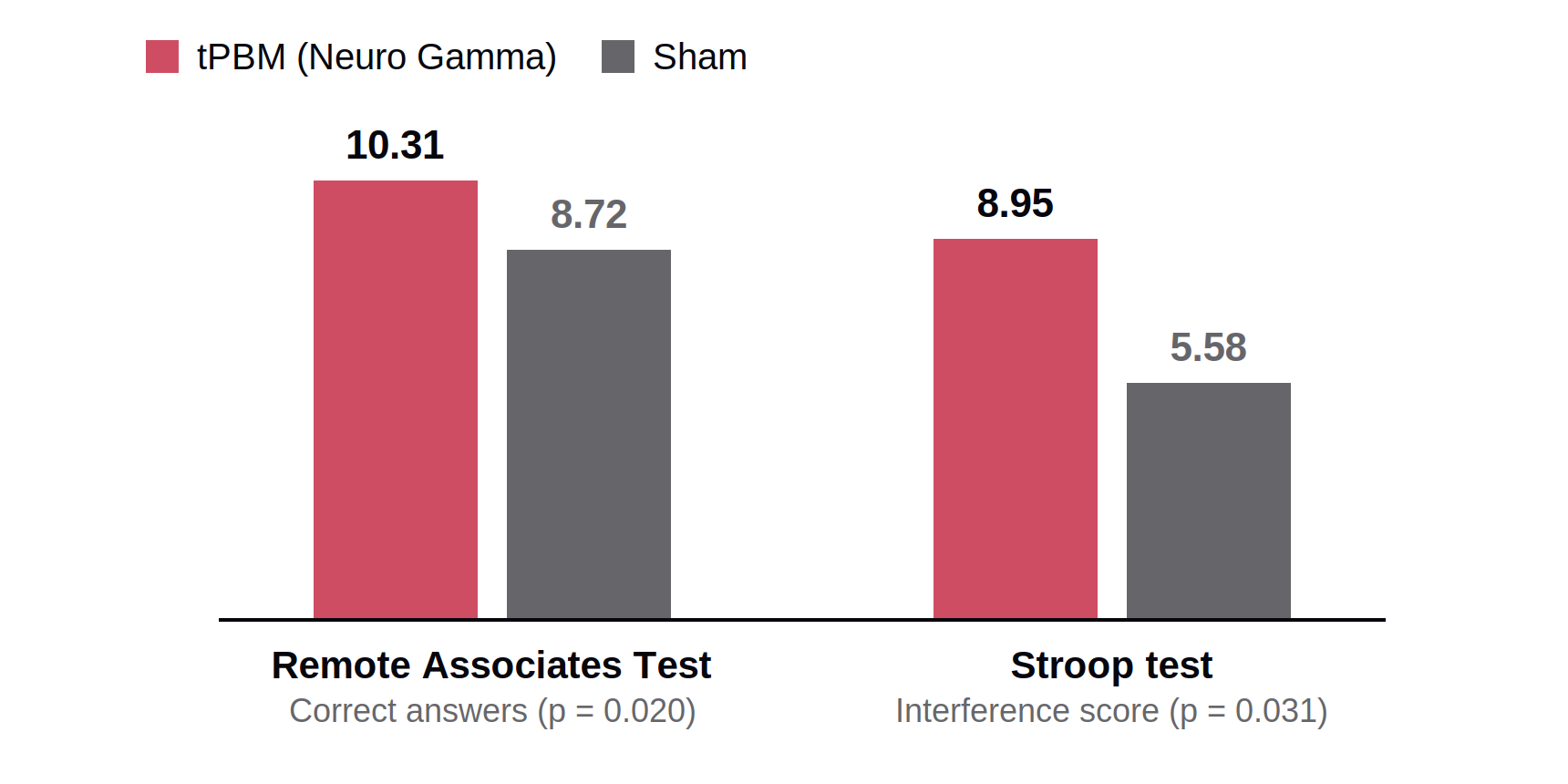
Scores during stimulation, adjusted for each person’s baseline. Higher is better on both tests. Source: Peña et al., 2026.
| Test | What it measures | Neuro Gamma vs sham (adjusted) | Result |
|---|---|---|---|
| Remote Associates Test | Verbal convergent thinking | 10.31 vs 8.72 correct | Significant (p = 0.020, ηp² = 0.098) |
| Stroop interference | Inhibitory control | 8.95 vs 5.58 | Significant (p = 0.031, ηp² = 0.085) |
| Picture Completion, fluency | Number of visual ideas | 7.37 vs 6.56 | Significant in an exploratory analysis (p = 0.031); the authors advise reading it cautiously |
| Picture Completion, total | Visual divergent thinking | 0.16 vs −0.16 (z-score) | Not significant (p = 0.073) |
| Language-Independent RAT | Visual convergent thinking | 6.32 vs 6.50 correct | Not significant (p = 0.833) |
| Unusual Uses, total | Verbal divergent thinking | 0.04 vs −0.04 (z-score) | Not significant (p = 0.688) |
In raw scores, the Neuro Gamma group went from 7.25 correct RAT answers at baseline to 9.75 during stimulation, while the sham group went from 9.07 to 9.29. The Neuro Gamma group started lower, which is why the primary analysis adjusts for baseline.
Two independent gains
The authors tested whether the Stroop improvement explained the problem-solving improvement. It did not. The two gains appear to be separate effects, and the authors suggest other executive processes, such as working memory, may drive the problem-solving result.
Aim the light, shape the result
The same Deusto team published an earlier tPBM study (Peña et al., 2023, Creativity Research Journal) that targeted hubs of the Default Mode Network, a network linked to generating ideas. That study improved divergent thinking but not convergent thinking. This study targeted the DLPFC, a hub of the executive control network that filters and refines ideas, and found the reverse.
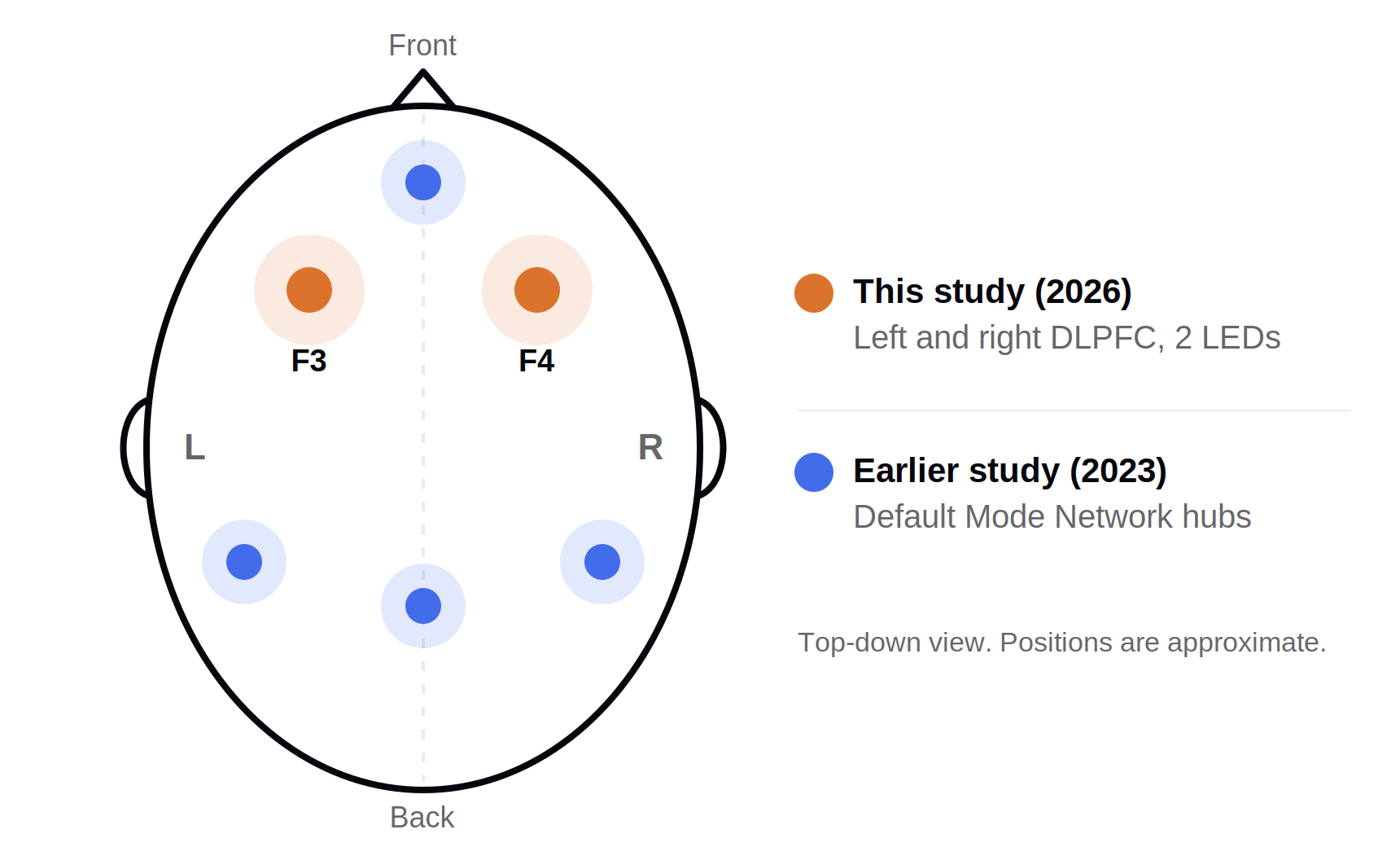
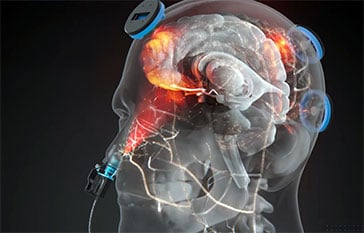
Where the light was aimed. This study targeted the DLPFC on both sides (orange). The earlier study targeted hubs of the Default Mode Network (blue).
| Target | Divergent thinking | Convergent thinking |
|---|---|---|
| Default Mode Network (Peña et al., 2023) | Improved | No significant change |
| Dorsolateral prefrontal cortex (Peña et al., 2026) | No significant change (total scores) | Improved (verbal) |
Read together, the two studies suggest near-infrared light can shift specific thinking skills depending on which brain network it reaches. That matches what brain imaging already shows: the Default Mode Network helps generate ideas, while the executive control network guides and refines them.
How near-infrared light is thought to work
The authors describe the widely supported mechanism. Near-infrared light is absorbed by cytochrome c oxidase in mitochondria, which increases cellular energy (ATP) availability. tPBM also increases nitric oxide, which widens blood vessels and raises regional blood flow and oxygen delivery. Unlike electrical or magnetic brain stimulation, it does not pass current through the scalp and skull, and the authors describe it as noninvasive, nonthermal and well tolerated.
Why this matters for Vielight
This is device-specific evidence. The Vielight Neuro Gamma is named in the paper’s methods, so the result speaks to this device rather than being borrowed from studies of other lasers or wavelengths. It joins more than 30 published studies using Vielight technology.
The study also sharpens a design principle. It used two transcranial LEDs over one region, and the outcome tracked the region reached. Vielight’s intranasal plus transcranial approach (itPBM) is built on that logic, pairing transcranial LEDs with an intranasal LED designed to deliver light to areas that are harder to reach through the scalp alone. This study did not test intranasal light, but it shows why reach matters.
Limitations noted by the authors
This was a single 20-minute session in healthy volunteers, so it shows short-term performance during stimulation, not lasting change. The authors also note:
- Both hemispheres were stimulated together, so left and right effects cannot be separated.
- Only 40 Hz pulsing was tested, and the best dose and light parameters remain open questions.
- Participants were an unpaid convenience sample, which may limit how widely the results apply.
- Testing at two time points can create practice effects that differ by task.
- The visual divergent thinking trend may have been limited by sample size, and no functional or long-term outcomes were measured.
What comes next
The authors call for longer studies across multiple sessions, research in educational settings, and pairing tPBM with brain imaging such as EEG and fNIRS. They note that wearable devices could make long-term, home-based use practical, which is the format Vielight devices are built for. For education, they suggest tPBM could offer a simple, noninvasive way to help strengthen structured reasoning alongside idea generation.
Explore Vielight Neuro devices
Browse the Vielight research library
Thank you to the research team
Careful, well-controlled studies like this one are how the field learns what photobiomodulation can and cannot do. We are grateful to the researchers who designed and ran it, to the 56 volunteers who gave their time, and to the public funders who made it possible.
| University of Deusto, Bilbao, Spain | Javier Peña, Irune Pérez, Agurne Sampedro, Olaia Lucas-Jiménez, Naroa Ibarretxe-Bilbao, Natalia Ojeda |
| SilverLine Research, Oxford, UK, and EuroMov, Université de Montpellier, France | Makii Muthalib |
| Pennsylvania State University, USA | Roger E. Beaty |
| Funding | Department of Education and Science, Basque Government (IT1545-22), and the Spanish Ministry of Science, Innovation and Universities (PID2024-157799OB-I00) |
Acknowledging the researchers does not imply that they or their institutions endorse Vielight or its products.
Reference
Peña, J., Muthalib, M., Beaty, R. E., Pérez, I., Sampedro, A., Lucas-Jiménez, O., Ibarretxe-Bilbao, N., & Ojeda, N. (2026). The impact of transcranial photobiomodulation on the bilateral dorsolateral prefrontal cortex in enhancing convergent thinking and Stroop test. The Journal of Creative Behavior, 60(2), e70112. https://doi.org/10.1002/jocb.70112 (open access)


