
 Shop Vielight tech












Biohacking and Brainmaxxing: What Actually Works for Brain Optimization
Focus has become one of the scarcest resources at work. Notifications, open tabs and AI tools that offer to do your thinking for you all pull on the same limited attention, and more people are deciding to push back.
A whole vocabulary has grown up around that push. Biohacking, brainmaxxing, cognitive fitness and neurowellness all describe the same instinct, which is to treat your brain as something you can train and support, for work and for the rest of your life.
Key takeaways
Biohacking, brainmaxxing and cognitive fitness: the rise of brain optimization
Biohacking is the practice of using habits, technology or treatments to improve health, performance or longevity, and brain optimization applies it to focus, memory and learning. Brainmaxxing is the newer, more informal name for the same pursuit.
Science writer Ethan Siegel described brainmaxxing in Big Think as the mental successor to lifehacking, and made the point that “there is no shortcut to proficiency.”
People also want their brains to last. In McKinsey’s 2025 Future of Wellness survey of more than 9,000 consumers in four countries, up to 60 percent said healthy aging was a top or very important priority, and consumers named cognitive health among the wellness needs still going unmet. The Global Wellness Summit listed neurowellness among its trends for 2026.
This guide covers the habits with the strongest evidence, what sham-controlled studies show about near-infrared light and the brain, and where Vielight fits.
How to biohack your brain: start with the fundamentals
Most of what makes a brain work well on a given day is unglamorous. These inputs have the strongest evidence behind them, and they are the foundation everything else builds on.
Much of the biohacking and brainmaxxing content online skips straight to supplement stacks and gadgets. That is backwards. Psychologists quoted by CNBC this year warned that the maxxing mindset can tip into perfectionism and anxiety when goals get rigid. A routine you can keep for years will do more than an extreme one you drop in a month.
Photobiomodulation: light and brain energy
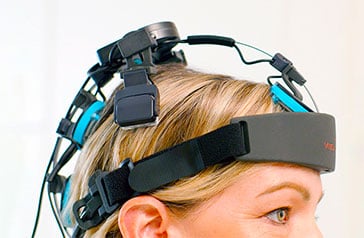
Most brain optimization tools work through habits, apps or supplements. Near-infrared light takes a different route, and is studied for how it interacts with the energy system inside brain cells. Photobiomodulation (PBM) is the use of specific wavelengths of red and near-infrared light to interact with cells. Vielight Neuro devices use 810nm near-infrared light, which passes through tissue far better than visible light.
The proposed mechanism runs through the mitochondria, the structures that supply each cell with energy.
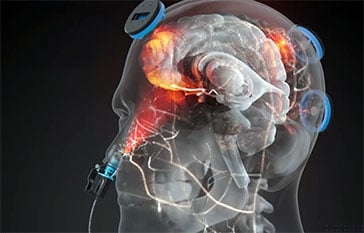
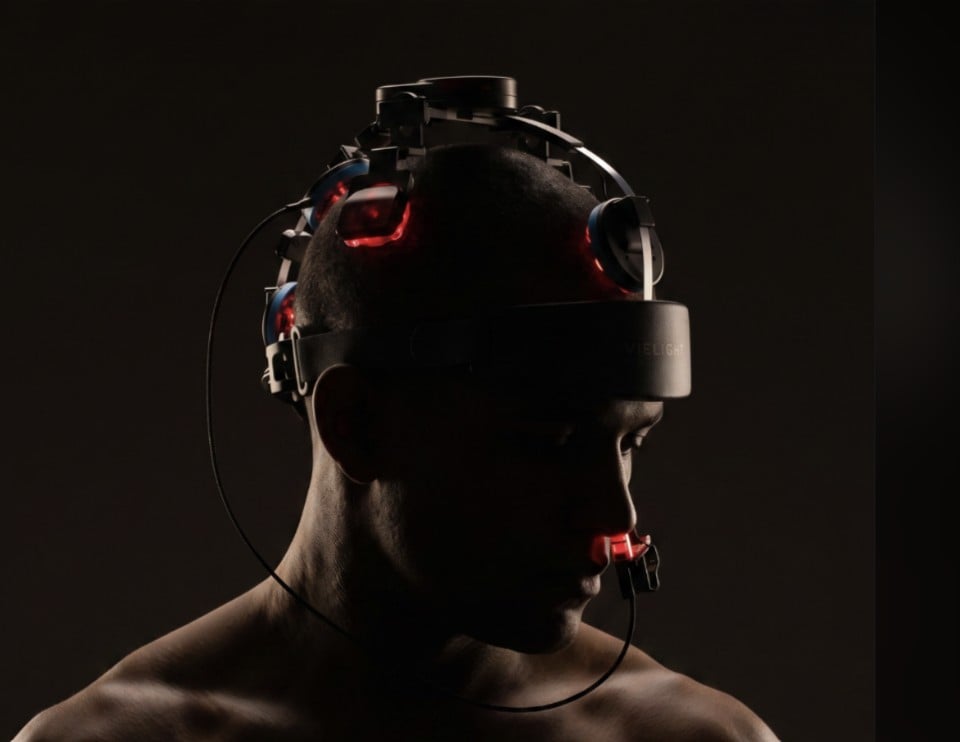
Getting the light there is the hard part. Light applied to the scalp has to pass through skin and bone, and much of it is lost before it reaches deeper regions. Vielight’s intranasal-transcranial design (itPBM) pairs transcranial Vie-LED modules on top of the head with an applicator that sits in the nostril. The nasal cavity lies directly beneath the cribriform plate, a thin, porous bone at the base of the skull, which gives light a second route to the underside of the brain.
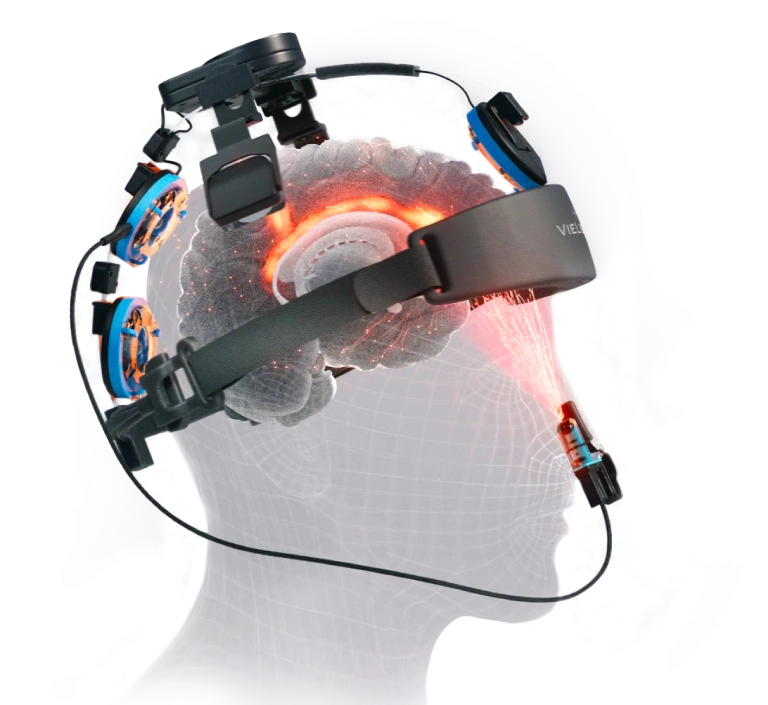
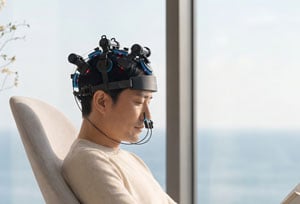
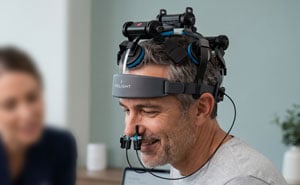
Vielight itPBM delivers 810nm near-infrared light through two pathways: transcranial modules on the head and an intranasal applicator in the nostril.
What the research shows
Four studies in healthy adults have looked at 810nm light and the brain. Each answers a different question, and together they build from whether light reaches the brain to what it does once it gets there.
Does the light reach the brain?
Both routes changed the flow of cerebrospinal fluid, the fluid that circulates through the brain. The nasal route produced a comparable change at roughly one twentieth of the power density, and its response did not depend on skin tone (full summary).
Does it change brain activity?
Compared with sham, faster brain rhythms (alpha, beta and gamma) increased and slower rhythms (delta and theta) decreased, along with changes in how brain networks connected. EEG was recorded before and after the session.
Does it change idea generation?
The default mode network is a set of regions active when the mind wanders and makes new connections. The active group scored higher than sham on divergent thinking, the ability to generate many ideas (η²p = 0.24 on the composite score). Convergent thinking did not change.
Does it change focus and problem-solving?
The active group solved more Remote Associates Test problems and scored higher on the Stroop test of focus. Divergent thinking did not change.
Scores during stimulation, adjusted for each person’s baseline. Higher is better on both tests. Read the full study summary.
Where the light goes matters
The idea-generation and focus studies came from the same team at Spain’s University of Deusto. Both used 810nm light pulsed at 40 Hz for 20 minutes, but aimed it at different brain networks. The results mirror each other. Aimed at the network linked to generating ideas, the light was followed by higher idea-generation scores. Aimed at the prefrontal cortex, it was followed by higher focus and problem-solving scores. In each case the other skill stayed largely unchanged.
Placement shapes the result. Light does the most when it is delivered to specific brain networks, not spread evenly across the head.
That is the thinking behind the Vielight Neuro. On the Neuro 4, five Vie-LED modules sit over key cortical networks, including the default mode network, and concentrate their output there. A typical PBM helmet takes the opposite approach, spreading 100 or more LEDs across a dome so the total power is distributed thinly over the whole head. The Neuro’s intranasal applicator then adds a route to the underside of the brain that a scalp-only helmet does not have.
For a closer look at how the two approaches compare, read Vielight itPBM: whole-brain vs half-brain coverage.
Where Vielight fits
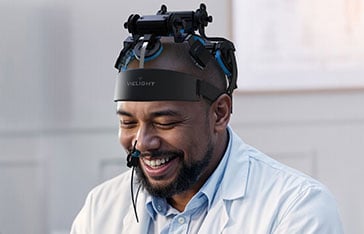
Every Vielight Neuro combines the targeted Vie-LED modules with the intranasal applicator, so light reaches key networks from above and the underside of the brain from below. The difference between models is the pulse rate.
Each Neuro 4 session runs 20 minutes on an automatic timer. Follow the session guidance in your device manual.
Frequently asked questions
Is biohacking the same as brainmaxxing?
The two overlap. Biohacking covers any attempt to adjust your biology, from diet to wearables. Brainmaxxing is narrower and focuses on the brain: attention, memory, learning and mental energy.
Does brainmaxxing work?
The parts built on sleep, exercise, focused work and steady practice are well supported. Shortcuts sold under the brainmaxxing label vary widely, and many have little evidence behind them.
Can near-infrared light support focus?
In a 2026 double-blind, sham-controlled study of 56 healthy adults, participants using the Vielight Neuro Gamma scored higher than sham on the Stroop test, a standard measure of focus, during a single 20-minute session. Smaller studies have reported shifts toward faster brain rhythms and higher creative thinking scores.
Why does Vielight use an intranasal applicator?
The nasal cavity sits directly beneath the cribriform plate, a thin bone at the base of the skull, which gives light a second route to the underside of the brain. In a 2025 Baycrest study of 45 healthy adults, intranasal light produced changes in cerebrospinal fluid dynamics comparable to transcranial light at roughly one twentieth of the power density.
How is Vielight different from a PBM helmet?
A typical PBM helmet spreads 100 or more LEDs across the whole head and delivers light through the scalp only. The Vielight Neuro 4 concentrates its output in five Vie-LED modules positioned over key brain networks, and adds an intranasal applicator that reaches the underside of the brain through the cribriform plate. See the full whole-brain vs half-brain coverage comparison.
How long is a Vielight session?
A Neuro 4 session runs for 20 minutes on an automatic timer. It is hands-free, so you can read or plan while it runs.
References
- Peña J, Muthalib M, Beaty RE, et al. (2026). The impact of transcranial photobiomodulation on the bilateral dorsolateral prefrontal cortex in enhancing convergent thinking and Stroop test. The Journal of Creative Behavior, 60(2), e70112. doi:10.1002/jocb.70112
- Peña J, Muthalib M, Beaty RE, et al. (2024). Enhancement of divergent creative thinking after transcranial near-infrared photobiomodulation over the default mode network. Creativity Research Journal, 36(1), 1 to 14. doi:10.1080/10400419.2023.2219953
- Zomorrodi R, Loheswaran G, Pushparaj A, et al. (2019). Pulsed near infrared transcranial and intranasal photobiomodulation significantly modulates neural oscillations: a pilot exploratory study. Scientific Reports, 9, 6309. doi:10.1038/s41598-019-42693-x
- PBM can modulate low-frequency dynamics of the cerebrospinal fluid (2025). Brain Stimulation. Full text
- McKinsey & Company (2025, May 29). The Future of Wellness trends survey 2025. mckinsey.com
- Global Wellness Summit (2026). The Future of Wellness 2026 Trends. Summary via CEW
- Merriam-Webster. Biohack, biohacking. merriam-webster.com
- World Health Organization. Physical activity fact sheet. who.int
- Siegel E. (2026, March 25). On brainmaxxing in the age of AI. Big Think. bigthink.com
- Onque R. (2026, July 11). From booksmaxxing to looksmaxxing: why mental health experts say too much self-optimisation can be harmful. CNBC, republished by The Nightly. thenightly.com.au


