Contact us!     1-877-355-8012  /  [email protected]

Vielight Logo
0

Your cart is currently empty.

Vielight Shop
0

Your cart is currently empty.

Vielight Logo
0

Your cart is currently empty.

Apollo Health and Vielight have formed a strategic partnership to support participants of the Bredesen Protocol with Vielight’s home-use brain stimulation technology.

Vielight technology has demonstrated major health benefits in independent, published studies by major universities.

Learn how Vielight Neuro Gamma technology improves elderly cognition and enhances the Bredesen Protocol.

Why Vielight technology?

Vielight technology is scientifically proven to enhance cognitive ability and increase cerebral blood flow.

  • In 2015, Vielight and Harvard Medical School’s dementia trial made history by showing efficacy for dementia in humans.
  • In 2019, the University of California verified our results with their own fMRI-based study with the Vielight Neuro Gamma.
  • 2019 onwards, we are running a 228-participant Phase 3 clinical trial for large-scale validation.

Watch the Apollo Health | Vielight webinar

Webinar transcript: Link
Presentation slide deck: Link

YouTube player

Why Vielight Works

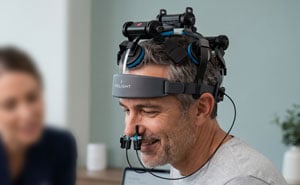
Vielight technology is simple and easy-to-use at home.

  • Cold NIR energy with power density of up to 100 mW/cm2 for superior penetration without generating heat.
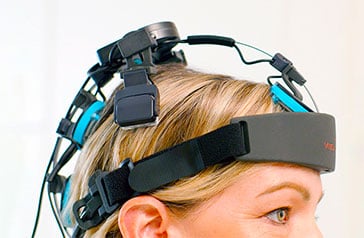
  • Modular form factor bypasses hair and maximizes ventilation, to prevent heat buildup.
  • Vie-LED technology is utilized and featured in the most published brain photobiomodulation studies.

Based on computer modelling, the 810nm wavelength has been found to be superior to other wavelengths that includes 1064 nm for penetration. This was proposed in 2018, and confirmed in 2020. Part of the explanation for the deeper penetration allowed for 810 nm is the low absorbance by blood and water.

recent studyon vascular hemodynamics and cytochrome c oxidase redox activity by the Department of Bioengineering, University of Texas at Arlington examined the effects of different wavelengths within this range with

  • Lasers (800-1064nm | 250 mW/cm2 )
  • 810nm LED (135 mW/cm2)

Results

(1) The 810 nm LED was able to create significant stimulations on vascular hemodynamic oxygenation and CCO redox metabolism despite the LED having a lower irradiance (≈135 mW/cm2)

(2) The dose-dependent trajectory by the 810 nm LED was similar to that by the 800 nm laser.

(3) The LED-triggered increases in Δ[oxCCO] remained at the elevated level without a returning tendency at least during the 5 min post-PBM period. In contrast, the increased Δ[oxCCO] by the 1064 nm laser started returning to the baseline immediately after the cease of the laser.

These findings are encouraging for us – our Vielight Neuro’s rear 810nm LED transcranial diodes generate ≈100 mW/cm2, which approaches the power density of ≈135 mW/cm2 used in the study. It underscores our commitment to fewer well-placed but sufficiently powerful diodes vs many weaker diodes.

Vie-LED technology enables fewer diodes with maximal output and footprint.

Each transcranial LED has an industry-leading power of 1000 mW. It allows us to program radiant power density of up 300 mW/cm2. Although we are currently limiting it to 100 mW/cm2 for safety reasons, we still lead the entire industry.

Our declared values for radiant power density are verified through medical-grade testing and manufacturing certifications.

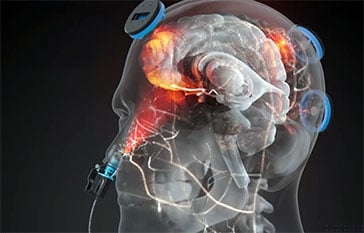
The ventromedial prefrontal cortex is a main hub of the DMN
Our patented intranasal technology enables access to it through the nose.

Why the Default Mode Network?

People with Alzheimer’s disease show disruptions of functional connectivity within the Default Mode Network (DMN).[1]

Brain photobiomodulation with the Neuro Gamma increased connectivity between nodes within the DMN in an fMRI-based research study by the University of California San Francisco.[2]

[1] Grieder M, Wang DJJ, Dierks T, Wahlund LO, Jann K. Default Mode Network Complexity and Cognitive Decline in Mild Alzheimer’s Disease. Front Neurosci. 2018 Oct 23;12:770. doi: 10.3389/fnins.2018.00770. PMID: 30405347; PMCID: PMC6206840.

[2]Chao LL. Effects of Home Photobiomodulation Treatments on Cognitive and Behavioral Function, Cerebral Perfusion, and Resting-State Functional Connectivity in Patients with Dementia: A Pilot Trial. Photobiomodul Photomed Laser Surg. 2019 Mar;37(3):133-141. doi: 10.1089/photob.2018.4555. Epub 2019 Feb 13. PMID: 31050950.

Neuro energy footprint and penetration.

Infrared capture of penetration and dispersion of 810nm light energy through a human cadaver.

Source: Infrared camera capture 
Institut für EEG Neurofeedback IFEN

Neuro Gamma-induced fMRI changes

Source: University of California San Francisco.

Default-mode network activity in the PBM group—(A) baseline and (B) week 12 and in the usual care group—(C) baseline and (D) week 12. The posterior cingulate cortex (1, -61, and 38) was used as seed in the analysis; Height threshold: Punc < 0.001; cluster threshold PFDR < 0.05.

An overview of Alzheimer’s research with the Vielight Neuro Gamma.

2015

First Alzheimer’s study

Significant Improvement in Cognition in Mild to Moderately Severe Dementia Cases Treated with Photobiomodulation
Co-authoring institutes – Harvard Medical School, Boston University School of Medicine

[ Published Study ( 2015) ]

2018

University of California – Independent Study

Effects of Home Photobiomodulation Treatments on Cognitive and Behavioral Function and Resting-State Functional Connectivity in Patients with Dementia
Institutes – University of California San Francisco & the Veterans Affairs USA

[ Published Study (2018) ]

2019

to present

Vielight Neuro RX Gamma – Pivotal Phase III Clinical Trial
Co-institutes – St Michael’s Hospital, Toronto

[ Clinical Trial Information Link (228 participants | 3 years | Ongoing)

Revitalizing Cognition in Older Adults at Risk for Alzheimer’s Disease With Near-Infrared Photobiomodulation


Institutes – University of Florida, University of Arizona, National Institute on Aging (NIA)

[ Clinical Trial Information Link (168 participants | 5 years | Registration)

Impact of Photobiomodulation (PBM) on Biomarkers of Alzheimer’s Disease
Institutes – University of California San Francisco


[ Clinical Trial Information Link / UCSF Clinical Trials (16 participants | 1.5 years | Ongoing)

Purchase Vielight Neuro Gamma.

Engineered for simplicity and efficacy, integrating Vielight technology for home-use is easy.

Add the Vielight Neuro Gamma today to complement the Bredesen protocol.
10% discount code: “APOLLO

Recommended protocol based on our phase 3 clinical trial: 6x a week, auto-timed 20 minutes.

Vielight devices are supported by a 6 month satisfaction guarantee for 80% of your money back.

Our dedicated customer support channels are ready to answer any questions.

Quick facts.

Vielight’s high-powered LED systems are proprietary and developed internally. Each transcranial LED has an industry-leading power of 1000 mW. These sophisticated LEDs have their own drivers and are not available to other companies. It allows us to program radiant power density of up 300 mW/cm2. Although we are currently limiting it to 100 mW/cm2 for safety reasons, we still lead the entire industry. Our declared values for radiant power density are verified through medical-grade testing and manufacturing certifications.

Additionally, our lenses were engineered with curvature to maximize contact with the scalp and bypass hair. This maximizes power density, as the amount of light energy that reaches the scalp can be hindered by hair and distance, according to the inverse square law of light.

Literature and our ongoing research with institutional research partners show that radiant power density is one of the most important variables for optimal penetration, besides wavelength.

Our patented intranasal technology enables photobiomodulation of the olfactory bulb and ventral brain structures.

The Neuro’s modules locations are adjustable, enabling different areas of the brain to be targeted.

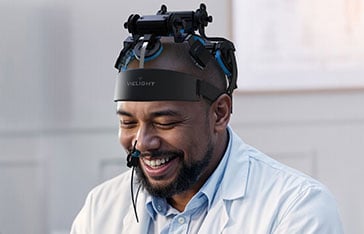
Flexible form factor maximizes contact of diodes with the scalp – bypassing hair and optimizing NIR light energy penetration.

In the field of brain photobiomodulation, our technology is featured in the most published research – spanning from neurodegeneration to brain performance. This is because we have been around the longest and have invested the most in advancing the field of brain photobiomodulation.

The Vielight Neuro Gamma is the only brain photobiomodulation device to induce Gamma neuromodulation in a peer-reviewed published study in a high impact journal.[1] Gamma neuromodulation is being researched by MIT and has been shown to improve brain function in humans with dementia.[2]

Besides that, improved brain connectivity and cerebral blood flow in an independent fMRI-based dementia study, which is the gold standard for determining physiological changes.[3][1] Zomorrodi R, Loheswaran G, Pushparaj A, Lim L. Pulsed Near Infrared Transcranial and Intranasal Photobiomodulation Significantly Modulates Neural Oscillations: a pilot exploratory study. Sci Rep. 2019 Apr 19;9(1):6309. doi: 10.1038/s41598-019-42693-x. PMID: 31004126; PMCID: PMC6474892.[2] Chan D, Suk HJ, Jackson BL, Milman NP, Stark D, Klerman EB, Kitchener E, Fernandez Avalos VS, de Weck G, Banerjee A, Beach SD, Blanchard J, Stearns C, Boes AD, Uitermarkt B, Gander P, Howard M 3rd, Sternberg EJ, Nieto-Castanon A, Anteraper S, Whitfield-Gabrieli S, Brown EN, Boyden ES, Dickerson BC, Tsai LH. Gamma frequency sensory stimulation in mild probable Alzheimer’s dementia patients: Results of feasibility and pilot studies. PLoS One. 2022 Dec 1;17(12):e0278412. doi: 10.1371/journal.pone.0278412. PMID: 36454969; PMCID: PMC9714926.[3] Chao LL. Effects of Home Photobiomodulation Treatments on Cognitive and Behavioral Function, Cerebral Perfusion, and Resting-State Functional Connectivity in Patients with Dementia: A Pilot Trial. Photobiomodul Photomed Laser Surg. 2019 Mar;37(3):133-141. doi: 10.1089/photob.2018.4555. Epub 2019 Feb 13. PMID: 31050950.

0