














Long-Covid Brain Fog Clinical Results: Objective Attention and Focus
For professionals struggling with Long COVID “brain fog,” the search for an objective, measurable solution has been incredibly frustrating. Up to 88% of individuals with Post-COVID Condition (PCC) report issues with attention, memory, and executive function.
Recently, we set a new benchmark in the pursuit of a solution. This Vielight itPBM clinical trial: published in the prestigious, “The Lancet” science journal, represents a rigorous, data-driven look at how iitPBM could restore cognitive performance.
This study is published in The Lancet (a prestigious Q1 Journal)
Please note that this article is based on published research with Vielight technology and does not constitute medical advice. Vielight technology is not FDA-approved for long-covid or brain fog.
Why itPBM for Long-COVID Brain Fog?
Long-covid brain fog is thought to arise from a combination of:
-
Neuroinflammation and microglial activation
-
Blood–brain barrier disruption
-
Impaired default mode network (DMN) connectivity
-
Mitochondrial dysfunction and impaired cellular energy production
The Science: Why 810 nm, itPBM and 40 Hz Matter
Photobiomodulation (PBM) isn’t just about light; it’s about cellular signaling. By utilizing near-infrared light (600–1100 nm), we can directly modulate biological pathways to support mitochondrial function, increase ATP production, and trigger anti-inflammatory responses.
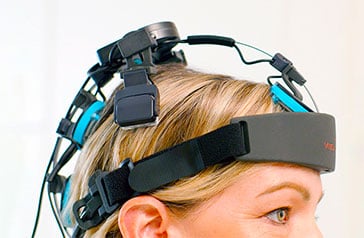
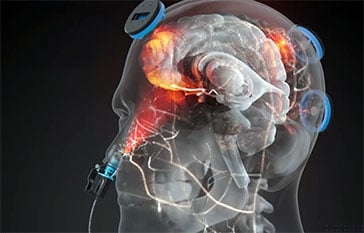
The Vielight Neuro RX Gamma utilizes a specific 810 nm wavelength, widely recognized as the “sweet spot” for deep tissue penetration and mitochondrial absorption. What makes this approach unique is the “itPBM” (intranasal + transcranial) delivery:
-
Transcranial: Targets the default mode network and cerebellum.
-
Intranasal: Provides a direct pathway to the underside of the brain, bypassing the thickest parts of the skull.
By pulsing this light at a 40 Hz gamma frequency, the device does more than just provide energy; it aims to “entrain” neural oscillations and modulate microglial activity. This trial was designed to see if this targeted, home-based intervention could effectively reverse the cognitive “static” associated with Long COVID.
The Trial Design: A Demand for Rigor
To separate physiological recovery from the placebo effect, the trial utilized a Randomized, Double-Blind, Sham-Controlled design.
-
The Cohort: 43 participants (23 active PBM, 20 sham).
-
The Intervention: 20-minute sessions, 6 days a week, for 8 weeks (56 days).
-
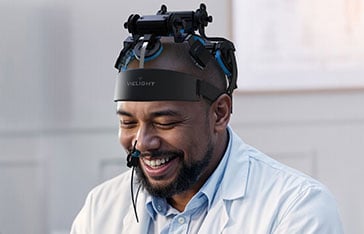
The Technology: The Vielight Neuro RX Gamma v2, delivering 810 nm near-infrared light pulsed at 40 Hz via a targeted intranasal and transcranial (itPBM) approach.
-
The Metric: Cognitive performance was objectively measured using the 7-task Creyos Research (formerly Cambridge Brain Sciences) battery.
Most were female (76.7%) and White, non-Hispanic (93%), with a mean age of 40.6 years.
The Hard Data: Age-Stratified Cognitive Gains
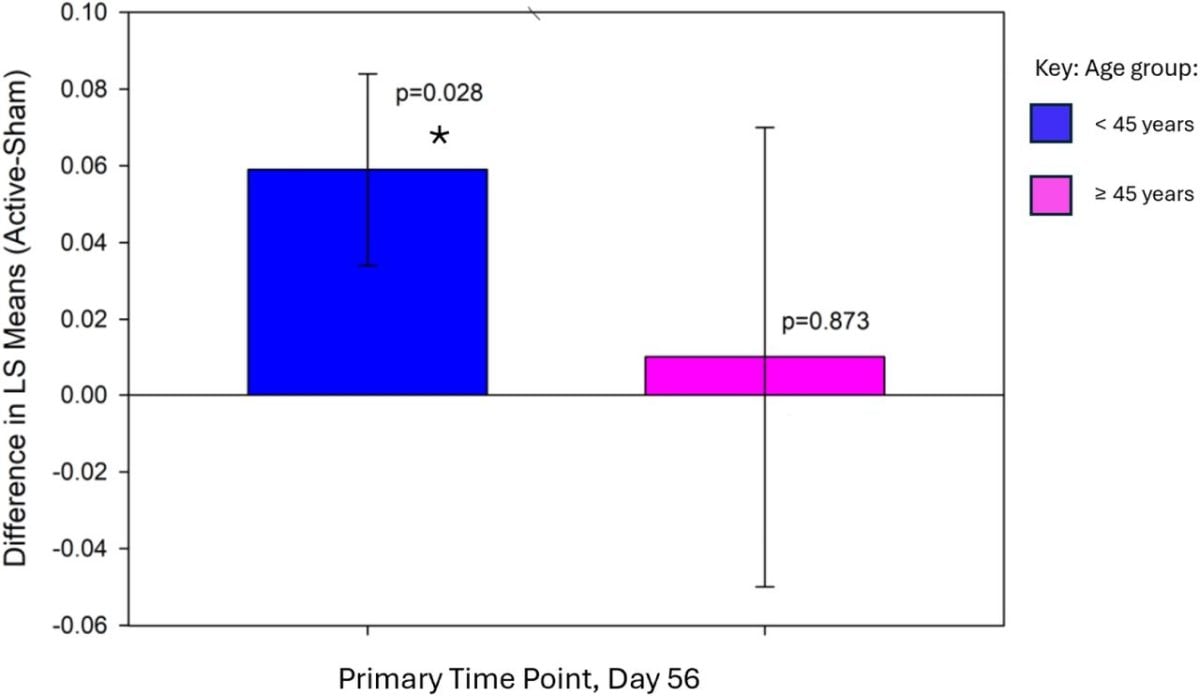
The most compelling data emerged when looking at the core of the active workforce—participants under the age of 45 (n=31).
When measuring the global composite index of cognitive performance (converted to Z-scores) at Day 56, the results were statistically significant:
-
Active PBM Group: +0.082
-
Sham Group: +0.023
-
The Difference: A medium effect size (Cohen’s d ≈ 0.44) with a p-value of 0.028.
In short, younger adults utilizing Vielight itPBM showed clear, statistically significant cognitive gains compared to the control group.
Focusing on the Data: The “Attention” Breakthrough
Brain fog isn’t just about memory; it’s about the inability to attend to the task at hand. Our data showed that Feature Match—a rigorous test of visual attention and pattern recognition—was the area where PBM truly shined.
The impact on Visual Attention (Feature Match) was the most robust and consistent across the board.
| Demographic | Peak Performance Timing | Significance |
|---|---|---|
| Full Sample | Day 28 & Day 84 | High |
| Ages 45+ | Day 28 & Day 56 | Early Success |
| Ages <45 | Day 84 | Sustained Growth |
Key Takeaways:
-
6 out of 7 tasks showed numerical favor for the active device.
-
Immediate & Lasting: For many, the “Attention” boost started by Day 28 and remained statistically significant even after the daily sessions ended (Day 84).
-
The Gamma Connection: This isn’t a random result. We believe the 40 Hz pulse specifically targets the brain’s attentional networks, helping to “sync” neural firing and reduce the “noise” of Long COVID.
Feasibility and Safety at Scale
Perhaps the most important finding for real-world application is the safety and compliance data:
-
Zero serious adverse events were reported.
-
High Adherence: 90% of participants achieved >80% compliance with their sessions.
-
Fully Remote: The entire trial was home-based, proving that clinical-grade neurotechnology can be practically and safely deployed outside of a hospital setting.
Strategic Takeaways: What the Data Tells Us
1. A Validated Signal for the Modern Workforce The itPBM (intranasal-transcranial) delivery via the Vielight Neuro RX Gamma provided a clear signal: targeted 40Hz pulses drive cognitive recovery. This was most pronounced in participants under 45, where improvements in attention and cortical network function reached statistical significance.
2. The Neuroplasticity Factor The age-dependent response suggests a “Plasticity Window.” While younger brains responded rapidly to the 8-week protocol, the data indicates that older cohorts or those with more chronic conditions may require maintenance dosing or a longer intervention to overcome lower baseline neuroplasticity.
3. The “Recovery Paradox”: Cognition vs. Fatigue An intriguing finding emerged: while cognitive scores rose, some physical fatigue measures favored the sham group. This suggests a “reframing” effect—as mental clarity returns, patients may become more acutely aware of their physical limitations, or “unmask” fatigue that was previously obscured by the fog.
4. Scalability as a Clinical Strength With zero serious adverse events and high adherence in a fully remote setting, this trial proves that clinical-grade neurotechnology is no longer tethered to the clinic. It is a scalable, safe, and practical solution for a global population.


