 Shop Vielight tech













Can Vielight Make You Smarter? What Published Clinical Research Says
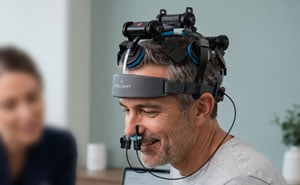
Can 20 minutes of near-infrared light help you think better? Two published trials at Spain’s University of Deusto put the Vielight Neuro Gamma to the test. In one, people came up with more original ideas. In the other, they solved more problems. Both were compared against a sham.
Both trials: one 20-minute session of 810 nm near-infrared light, pulsed at 40 Hz. Published in peer-reviewed journals. Two more sham-controlled studies show the light changes brain activity in healthy adults (see 05).
Watch: the problem-solving trial in under three minutes. Open on YouTube
01 How the trials worked
Both trials followed the same simple, rigorous recipe. Test people, split them at random, give half real light and half a sham, then test again.

Study 1 tested 58 healthy adults. Study 2 tested 56 and was double-blind.
✓
✓
✓
✓
✓
✓
02 Two kinds of smart
“Smart” is not one thing. Scientists test separate thinking skills, and these trials focused on two of the most useful.

Creative thinking was measured with idea-generation tasks. Problem-solving was measured with the Remote Associates Test.
Study 2 also measured attention control with the Stroop test: name the ink color of the word “RED” printed in blue. The Neuro group scored higher on that too.
03 The results

Higher bars are better. Each study also measured the other skill; see the note below the table.
Scores adjusted for each person’s starting score. Each study also measured the other skill: Study 1 found no significant change in problem-solving, and Study 2 found no significant change in total creativity scores. Full details: Study 1 summary and Study 2 summary.
04 Aim the light, shape the result
Same research team, same device, same light, same 20 minutes. The main difference was where the light went.

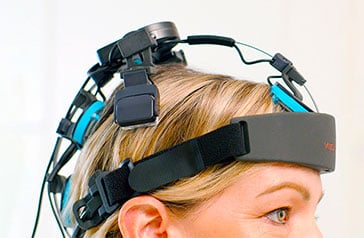
Study 1 used the full headset, including the intranasal module. Study 2 used two transcranial modules.
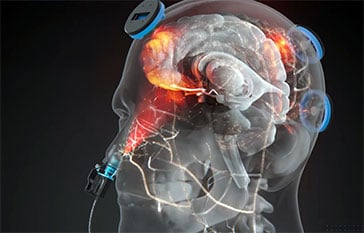
Light aimed at the brain’s idea network (the Default Mode Network) boosted creativity. Light aimed at the prefrontal cortex, the brain’s planning and control center, sharpened problem-solving.
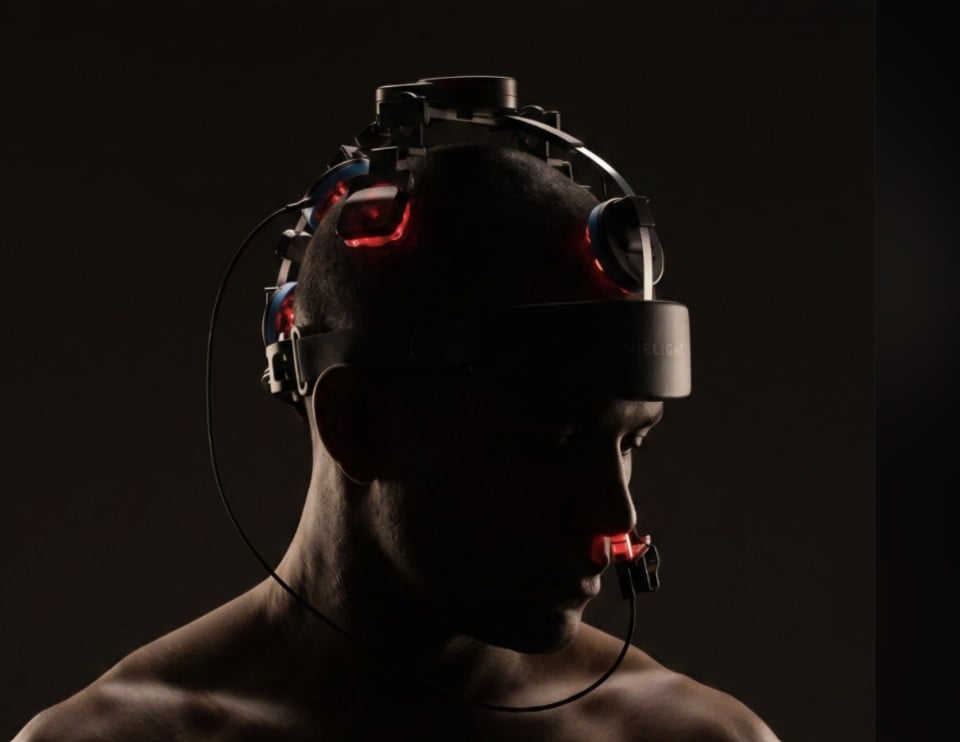
That is the idea behind the Neuro’s modular design: separate 810 nm Vie-LED modules, each placed over a target region, plus an intranasal module for areas that are hard to reach through the skull.
05 What happens in the brain
Two more sham-controlled studies looked at the brain itself after one 20-minute session in healthy adults. They did not test thinking skills, but they show the light measurably changes brain activity.

After one session, resting brain rhythms shifted toward faster patterns compared with sham.
The EEG study’s authors were affiliated with or paid by Vielight. The University of Sydney fMRI team had no Vielight affiliation and bought the device themselves. Neither study measured thinking performance.
Together with the two thinking trials, they build a consistent picture: the light reaches the brain, changes its activity, and in controlled tests, people performed better on specific thinking tasks.
06 What we don’t know yet
- How long it lasts. Each trial tested a single session. Regular use has not been studied yet.
- IQ. Neither trial measured IQ, grades or work performance.
- Who it applies to. The thinking trials tested healthy adults with an average age of about 28. The EEG study tested healthy adults aged 61 to 74 but did not measure thinking skills.
- Both setups together. The full headset and the two-module prefrontal setup have not been tested side by side.
The researchers’ next step: longer studies with repeated sessions.
07 The thinking trials at a glance
Both studies used an earlier-generation Neuro Gamma with four transcranial modules. Current Neuro 4 headsets have five transcranial Vie-LED modules plus the intranasal module; see the Neuro 4 user guide.
08 Watch Dr. Peña’s full lecture
Dr. Javier Peña, professor of psychology at the University of Deusto in Bilbao, Spain, presents his research on near-infrared light and creative thinking in healthy adults.
Watch: Dr. Peña’s full lecture on near-infrared light and creative thinking (52 minutes). Open on YouTube
Quick answers
Can Vielight make you smarter?
In two randomized, sham-controlled trials, one 20-minute session with the Vielight Neuro Gamma led to more original ideas (58 adults) and more problems solved (56 adults) compared with a sham.
Does the light actually change brain activity?
Yes, in healthy adults. In two sham-controlled studies, one 20-minute session changed resting brain rhythms (EEG, 20 adults aged 61 to 74) and task-related brain activity (fMRI, 24 young adults) compared with sham.
Does Vielight raise IQ?
IQ was not measured. The trials measured specific skills: creativity, problem-solving and attention control.
How fast did it work?
Within one 20-minute session. In Study 2, the gains showed up while the light was on.
Do the effects last?
Not yet known. Both trials tested a single session.
Sources
- Peña J, Muthalib M, Beaty RE, Sampedro A, Ibarretxe-Bilbao N, Zubiaurre-Elorza L, García-Guerrero MA, Cortazar I, Niso M, Ojeda N. Enhancement of divergent creative thinking after transcranial near-infrared photobiomodulation over the default mode network. Creativity Research Journal. 2024;36(1):1-14. doi:10.1080/10400419.2023.2219953
- Peña J, Muthalib M, Beaty RE, Pérez I, Sampedro A, Lucas-Jiménez O, Ibarretxe-Bilbao N, Ojeda N. The impact of transcranial photobiomodulation on the bilateral dorsolateral prefrontal cortex in enhancing convergent thinking and Stroop test. The Journal of Creative Behavior. 2026;60(2):e70112. doi:10.1002/jocb.70112
- Zomorrodi R, Loheswaran G, Pushparaj A, Lim L. Pulsed near infrared transcranial and intranasal photobiomodulation significantly modulates neural oscillations: a pilot exploratory study. Scientific Reports. 2019;9:6309. doi:10.1038/s41598-019-42693-x
- El Khoury H, Mitrofanis J, Henderson LA. Exploring the effects of near infrared light on resting and evoked brain activity in humans using magnetic resonance imaging. Neuroscience. 2019;422:161-171. doi:10.1016/j.neuroscience.2019.10.037
- Vielight Inc. Getting Smarter with Vielight? Published Analytical Reasoning Trial. YouTube, November 2026. Video
- Vielight Inc. Neuro 4 User Guide (2026). PDF


