















Is 810nm or 1064nm/1070nm better for brain photobiomodulation?
Key takeaways: 810nm vs 1064nm/1070nm for Brain PBM
-
Penetration Depth: 810nm shows stronger brain penetration and cortical energy deposition than 1064nm in Harvard Medical School research and several other brain PBM penetration studies. A direct 810nm vs 1070nm tPBM penetration study also found higher measured transmittance for 810nm.
-
Mitochondrial Action: Cytochrome c oxidase (CCO) has near-infrared absorption features peaking around 800nm and decreases onwards to 1000 nm. 1070nm appears to rely more on a secondary photothermal mechanism.
-
Dosimetry & Power: Harvard Medical School research supports 810nm as the highest-energy-deposition wavelength tested, while direct cadaver testing found that 810nm delivered over 2.2x more cortical irradiance than 1070nm under tested conditions.
- Clinical Devices: Current helmet-style 1070nm devices may suffer from low irradiance, making sufficient cortical delivery difficult when wavelength, power output, scalp coupling, and device geometry are not optimized.

Harvard Wavelength Comparison Study
A landmark transcranial dosimetry study by the Harvard Medical School Department of Psychiatry evaluated how effectively different wavelengths deliver energy to cortical brain targets. The researchers found that 810 nm produced the highest energy deposition among the wavelengths tested, including 1064 nm.
The hierarchy of penetration and energy-deposition effectiveness was:
-
810 nm – consistently highest across all age groups and regions
-
850 nm and 1064 nm (1070nm) – next most effective in most cases
-
670 nm and 980 nm – lowest deposition overall
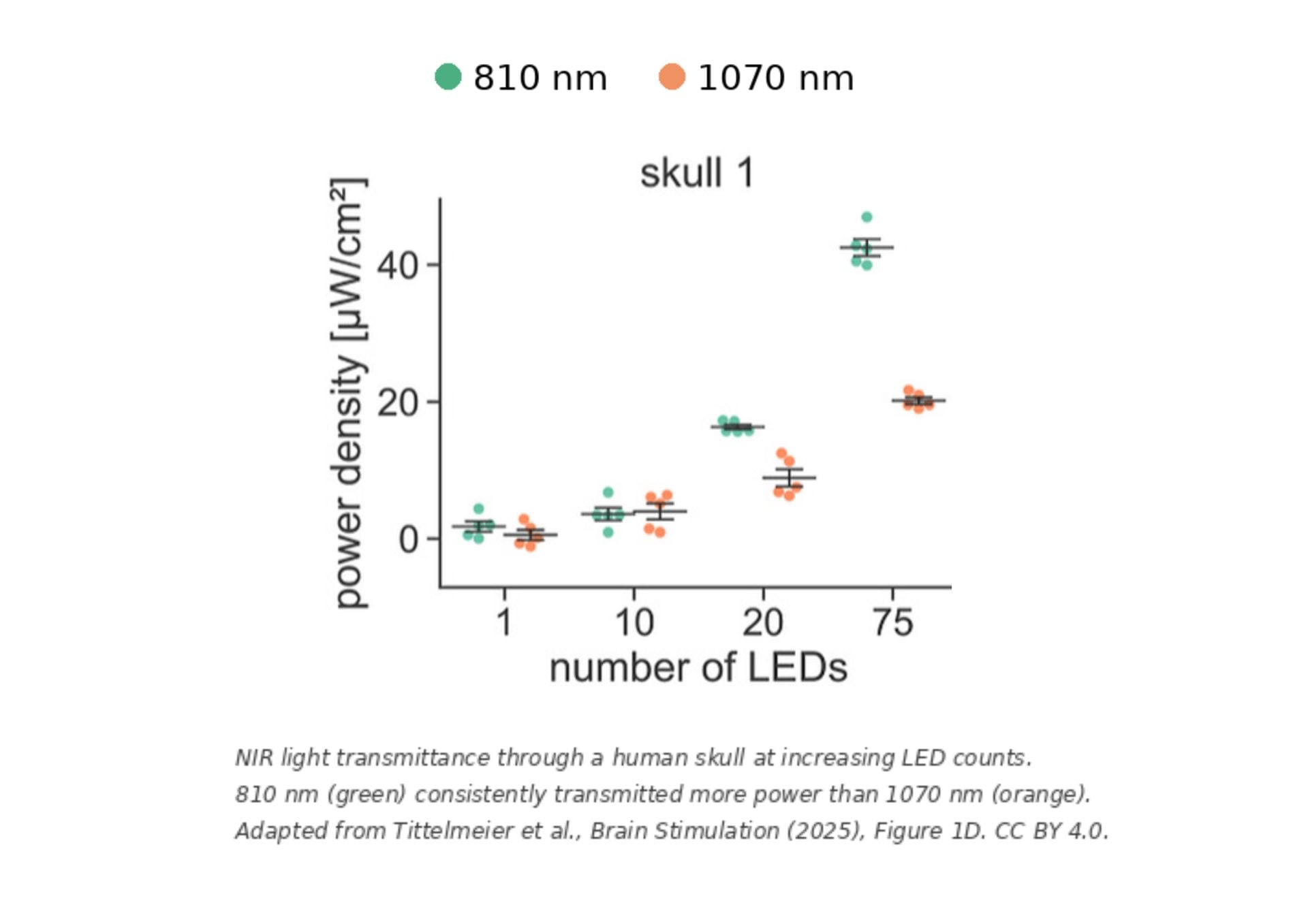
NIR light transmittance through a human skull. 810nm consistently transmitted more power than 1070nm.
Head-to-head tPBM study: 810nm penetrates 2.2× more than 1070nm
A head-to-head wavelength study reinforced these findings. The study, published in Brain Stimulation (Tittelmeier et al.), measured how much NIR light from two non-Vielight commercial helmets penetrates a cadaver that retained skin, subcutaneous tissue, cranial bone and dura mater.
The researchers compared 810nm and 1070nm helmets with 256 LEDs each.
Their measurements showed:
810 nm: 0.71% transmittance (41 μW/cm²)
1070 nm: 0.45% transmittance (19 μW/cm²)
810 nm delivered 2.2× more transmitted irradiance throughthe same head tissues. This direct 810 nm vs 1070 nm comparison is consistent with the Harvard and Wang & Li dosimetry findings above: longer wavelength does not mean better cortical light delivery.
The authors also concluded that the tested low-level tPBM helmets delivered insufficient irradiance after skull attenuation to reliably activate CCO. This reinforces an important brain PBM principle: the right wavelength must be paired with sufficient irradiance and delivery designs that reduce skull attenuation, such as Vielight’s combined intranasal-transcranial PBM approach.
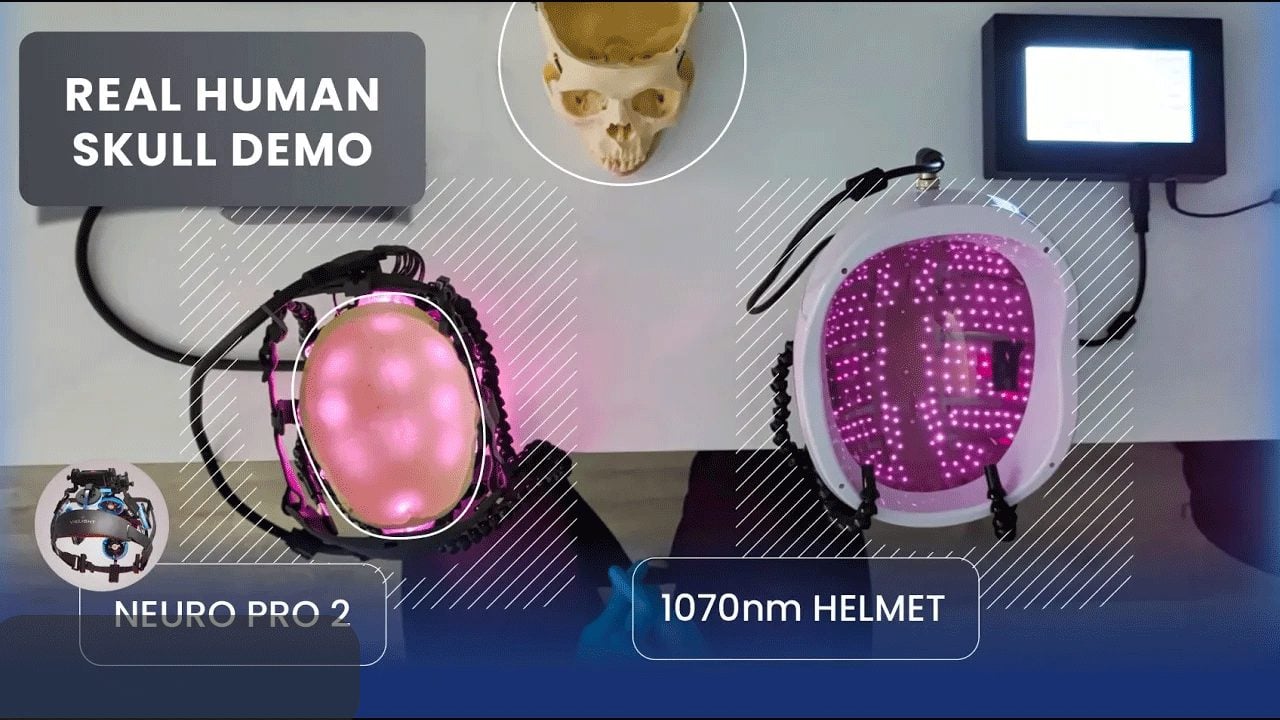
The Vielight Difference: Near-Infrared Light Penetrating the Skull with Vielight Neuro
The Tittelmeier et al. (2025) comparison study used standard 810nm and 1070nm helmets with 256 LEDs each. The authors concluded both non-Vielight helmets were underpowered for therapeutic efficacy.
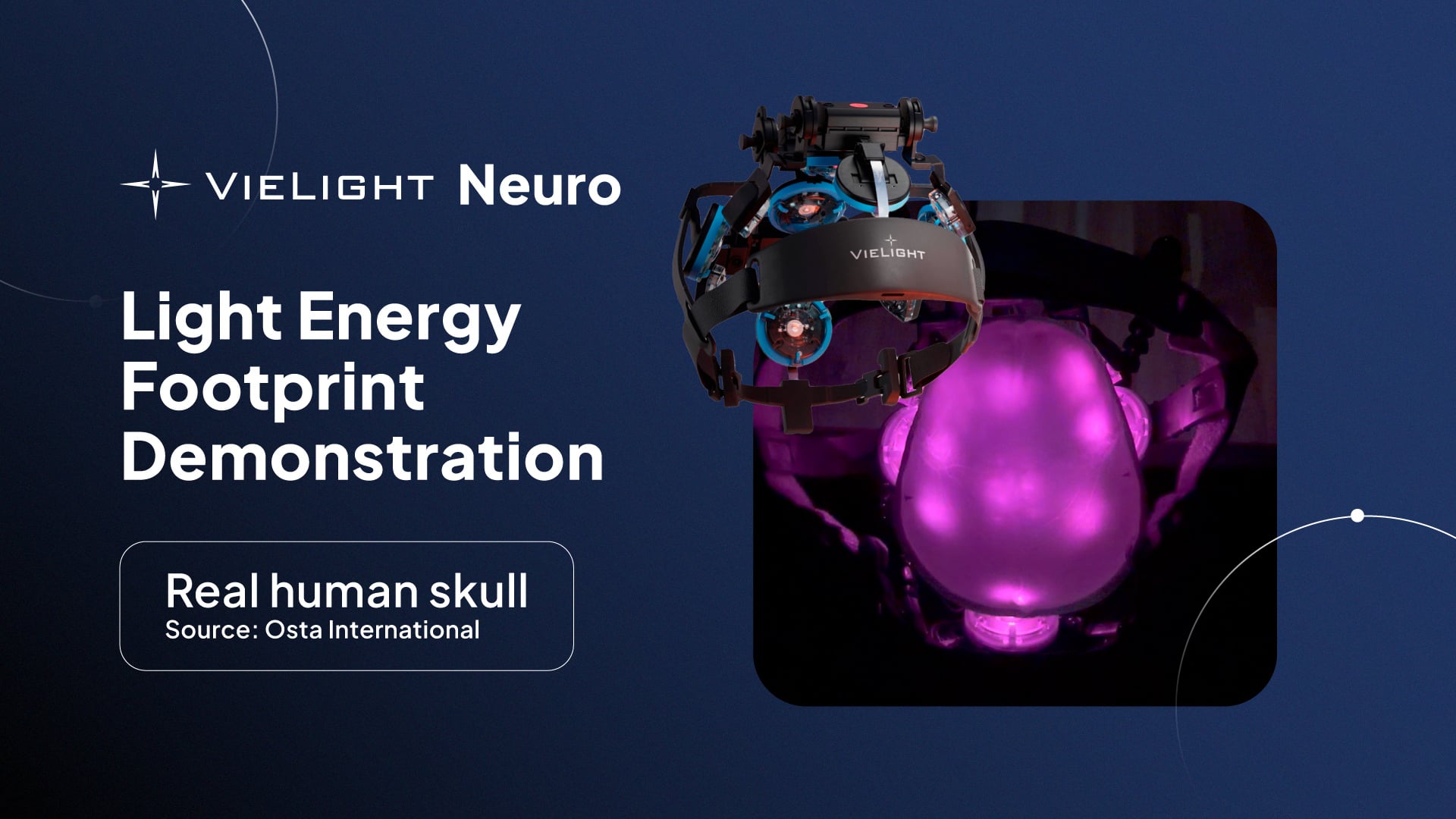
The demonstration video shows what happens when that same 810nm wavelength is delivered with Vie-LED technology at irradiance levels of 300-400 mW/cm². Placed against a real human skull alongside a comparable 1070nm 256 LED helmet, the result is unambiguous: 810nm light passes through the calvaria entirely. The 1070nm helmet cannot be visibly detected.
The wavelength advantage was already confirmed in peer-reviewed data. This is what it looks like at therapeutic irradiance.

The distribution of photon fluence at 660 nm, 810 nm, 980 nm and 1064 nm. Image source: https://doi.org/10.1002/jbio.201800173
Peking University: 810nm vs 1064nm (1070nm) Transmission Study
A transcranial PBM light transmission study by Peking University comparing 660 nm, 810 nm, 880 nm and 1064 nm (1070 nm) also supports 810nm as superior over 1070nm for penetration. They concluded that the photon fluence (light distribution) within the brain was vastly wider and deeper at 810 nm than at 1064 nm.

The body’s optical window. Image source: https://doi.org/10.1016/B978-0-12-815305-5.00005-1
The Role of Water Absorption and the First Optical Window in Brain PBM
The differences in dosimetry are supported by a well-established biological principle, the body’s first optical window. While, the 1064 and 1070nm wavelengths are longer, they are more strongly absorbed by water, which is abundant in biological tissues, especially the human. The brain consists of 70-80% water, and floats in cerebrospinal fluid (CSF) while the rest of the human body is approximately 60% water. This makes wavelengths like 1064 nm and 1070 nm particularly susceptible to water absorption within the brain.
While 810nm light is preferentially absorbed by chromophores like cytochrome c oxidase in mitochondria and hemoglobin in the blood, 1070nm light is more significantly absorbed by water, which is the primary chromophore for that specific wavelength.
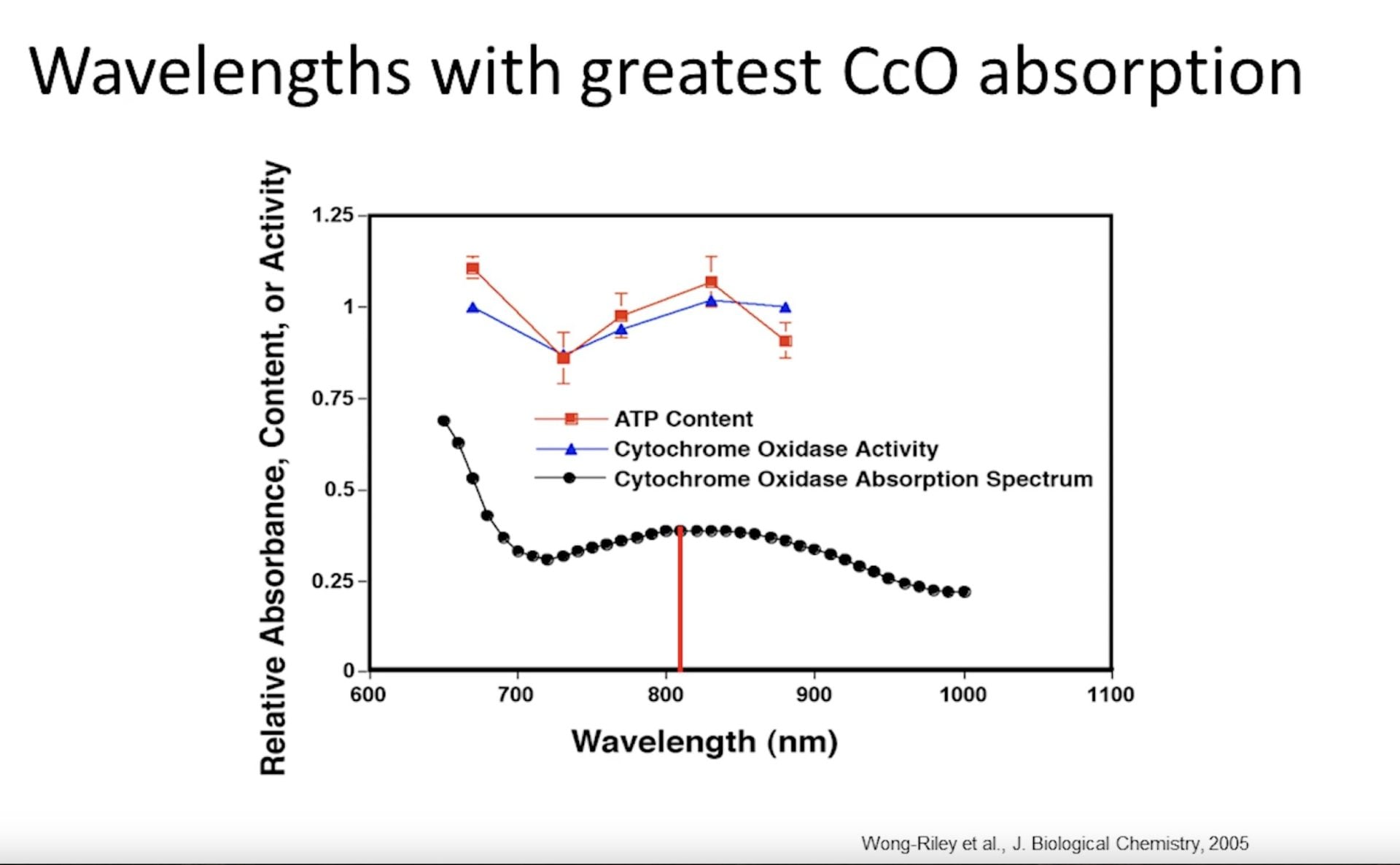
Wwavelengths with greatest CCO Absorption. Image source: https://doi.org/10.1074/jbc.M409650200
Differences in cellular effects between 810nm and 1070nm
- 810nm has a stronger effect on mitochondria, cytochrome C oxidase (CCO) The 810nm wavelength is well-known for its strong interaction with cytochrome c oxidase (CCO), a key enzyme in the mitochondrial respiratory chain. By enhancing the activity of CCO, the 810nm wavelength increases ATP production, reduces oxidative stress, and modulates reactive oxygen species (ROS). These effects are crucial for cellular energy metabolism, neuroprotection, and the promotion of cell survival.
- 1064 nm and 1070nm has a stronger effect on heat-sensitive ion channels
On the other hand, for wavelengths beyond 900nm, such as the 1064nm and 1070nm wavelengths, mitochondrial CCO absorption drops off significantly but has a more direct effect on heat-sensitive ion channels, due to its potential to cause localized heating. Activation of these channels can lead to increased calcium influx, which is crucial for various cellular processes, including neurotransmitter release, gene expression, and neurogenesis.
Why mitochondria absorbs 810 nm more than 1064 nm (1070nm)
1. Spectral absorption properties of cytochrome c oxidase (CCO) within mitochondria
Cytochrome c oxidase (CCO), located within the inner mitochondrial membrane, exhibits distinct absorption bands in the visible red (~660 nm) and near-infrared (~810 nm) regions of the electromagnetic spectrum. Its absorption peak in the NIR window occurs at approximately 810 nm.
Absorption efficiency drops substantially at longer wavelengths: studies confirm that CCO absorption bands become much weaker beyond 900 nm, and absorption continues to decrease toward the 1000 nm range. As a direct consequence, 810 nm light is absorbed by CCO significantly more efficiently than 1064–1070 nm light.
This absorption falloff beyond 900 nm also implies that biological effects observed at wavelengths such as 980 nm are likely mediated by alternative chromophores – such as temperature-gated calcium ion channels – rather than CCO itself.
2. Reduced photon availability at 1064 nm (1070 nm)
At ~1064 nm (1070nm), water (the dominant tissue component) is absorbed significantly versus 810 nm. This leads to greater attenuation (loss) of photons before they can reach and excite CCO.
Net result: 810 nm light reaches CCO more efficiently and is absorbed by it more strongly. 1064–1070 nm light is attenuated by water before reaching mitochondria, and what does arrive finds a chromophore (CCO) that is poorly tuned to that wavelength.
Why calcium ion channels respond more to 1064 nm (1070 nm) Than 810 nm
Calcium ion channels do not absorb light directly. The mechanism is indirect, wavelength-dependent, and physically distinct from CCO photochemistry:
At ~1064–1070 nm — Photothermal pathway: Water’s strong absorption above 1000 nm generates rapid, localized temperature rises. These micro-thermal events gate heat-sensitive transient receptor potential (TRP) channels — particularly TRPV1, TRPV2, and TRPV4 — and alter membrane capacitance, both of which drive Ca²⁺ influx. This is a photothermal effect mediated by water, not a direct photon-channel interaction.
Summary table: biological effect differences
| Property | 810 nm | 1064–1070 nm |
|---|---|---|
| Primary tissue absorber | CCO (mitochondria) | Water |
| Reaches CCO efficiently? | Yes | No — attenuated by water |
| CCO absorption strength | High (peak ~810 nm) | Negligible (>900 nm falloff) |
| Ca²⁺ mechanism | Indirect, via mitochondrial signaling | Direct TRP channel gating via heat |
| Effect type | Photochemical | Photothermal |
The 1064nm Pruitt et al. Laser Study: Addressing Misrepresentations
The 2022 Pruitt et al. study, commonly cited by 1064nm/1070nm proponents, does not support the claim that 1070nm is superior to 810nm for brain photobiomodulation. It involved 1064nm laser light on forearm skin – not 1070nm LED light on a human brain.

The Claim: “1064nm/1070nm is more effective for brain health because it shows better mitochondrial response in human studies.” (Study Link: Pruitt et al., 2022).
The Scientific Reality: The study titled “Comparison of 808 nm and 1064 nm Lasers on Mitochondrial Function” and its application to brain PBM is a significant misrepresentation for three reasons:
-
Anatomical Error: This study was conducted on human forearm muscles (soft tissue), which lack the dense barrier of the human skull and the high water content of Cerebrospinal Fluid (CSF).
-
Wavelength Physics: The brain is roughly 80% water, fundamentally different from forearm tissue. Neural tissue is different from forearm tissue, which doesn’t guarantee the same outcome.
-
The Missing 1070 LED Comparison: While the study compared 808nm and 1064nm lasers, it did not test 1064nm/1070nm LEDs. Crucially, the study included an 810nm LED as a reference, which produced substantial and statistically significant increases in mitochondrial activity (oxidized CCO) at an irradiance of 135 mW/cm².
-
Different Spectral Profiles: Lasers are monochromatic. LEDs are quasi-monochromatic and divergent (spreading).
-
The Irradiance Gap: Beyond the “Forearm Fallacy,”
There is a fundamental mismatch in irradiance vs existing 1070nm commercial devices. The Pruitt et al. (2022) study utilized high-power lasers delivering up to 200 mW/cm² to achieve mitochondrial activation.
Current 1064 nm and 1070nm transcranial LED devices are significantly weaker at only 9-40 mW/cm² is a significant scientific misrepresentation.
-
Mechanism Misattribution (Photochemical vs. Photothermal)
The study potentially misinterprets the biological effect observed with high-powered 1064nm laser as mitochondrial activity. At the high laser irradiances used in the study (200 mW/cm2), this creates a photothermal effect, heating the tissue to trigger heat-gated ion channels that indirectly increase metabolic activity.
| Parameter | Pruitt et al. 2022 (The Cited Study) | Vielight Neuro | Neuronic Neuradiant 1070 |
|---|---|---|---|
| Light Source | High-Power Laser (MDL-III) | High-Irradiance Vie-LED | LED Array |
| Irradiance | 100 – 200 mW/cm² | 100 – 400 mW/cm² | ≈ 9 mW/cm² |
| vs. Study Parameters | Research Standard | Matches / Exceeds | ~95% Underpowered |
Sources: Pruitt et al., Metabolites, 2022 (DOI: 10.3390/metabo12020103); PBM Foundation / Optronic Labs, 2024.
Wavelength alone isn’t enough – irradiance matters.
Irradiance or surface power density is a measure of how much light energy reaches a surface per unit area, typically expressed in milliwatts per square centimeter (mW/cm²). In photobiomodulation (PBM), including brain PBM, irradiance determines how much photonic power is delivered to the tissue.
While using an effective wavelength (such as 810 nm, 1064 nm, or 1070 nm) is essential for targeting chromophores like cytochrome c oxidase, the biological response and penetration depth depends just as much on irradiance. Without sufficient power density, even the correct wavelength may fail to penetrate tissue effectively or trigger meaningful cellular effects. Low irradiance can result in sub-therapeutic penetration and doses, while excessively high irradiance may lead to phototoxicity or energy wastage.
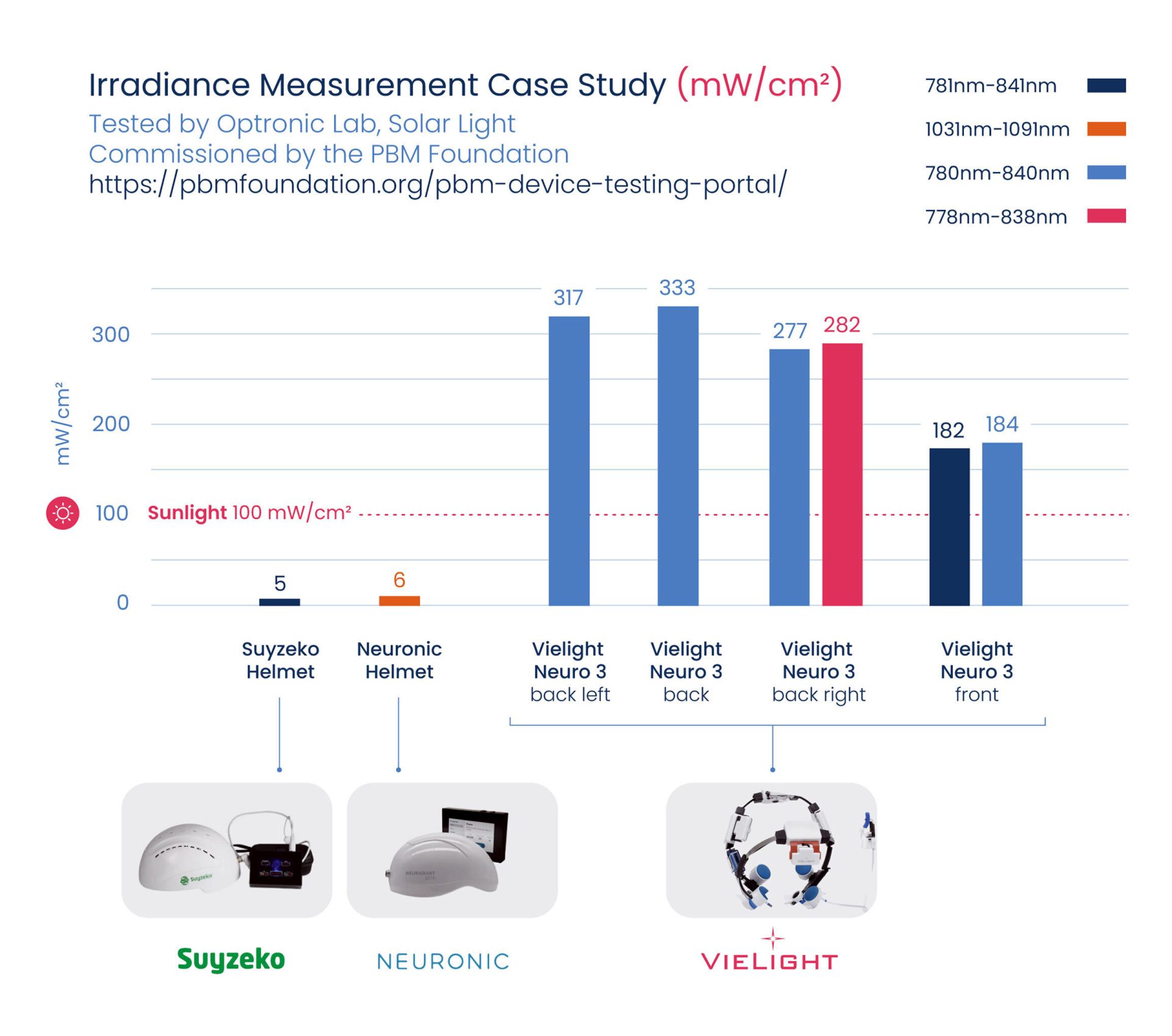
Data Source: The PBM Foundation’s Device Testing Portal - https://pbmfoundation.org/pbm-device-testing-portal/
A Comparative Snapshot
In a 2024 systematic review that screened 2,133 records and included 97 brain-PBM studies, reported power densities typically clustered around ~250 mW/cm² (especially under physiological conditions).
This is a snapshot comparison of independently measured irradiance by photonics labs by the PBM Foundation between commercial devices with the 810nm wavelength and the 1064 nm, 1070nm wavelengths.
The PBM Foundation benchmarked the Vielight Neuro 3 against two PBM helmets, the Suyzeko NIR helmet and Neuronic Neuradiant twice, as case studies for their testing program to standardize irradiance reporting.
MegaLab and Optronic Lab, photonics engineering firms, conducted the tests:
| Source | Independently measured irradiance | Manufacturer | % of Typical Brain-PBM Irradiance (≈250 mW/cm²) |
|---|---|---|---|
| Vielight Neuro (Vielight) | 180-350 mW/cm2 | Vielight, Canada | 80–160% |
| Neuradiant 1070 (Neuronic) | ≈9 mW/cm2 | Suyzeko, China (Private-labelled) | ≈4% |
| Suyzeko PBM Helmet (Suyzeko) | 5 mW/cm2 | Suyzeko, China | 3% |
| Natural Sunlight | 100 mW/cm2 | Free | 40% |
810nm Brain Penetration Superiority: Evidence Across Six Independent Study Types
A common misconception in photobiomodulation is that the 1070nm wavelength automatically guarantees deep brain penetration. However, recent clinical and independent lab data demonstrate that when 1070nm is deployed in a helmet-style device, it critically fails to deliver an effective therapeutic dose to the cortex. This failure is due to a combination of heavy water absorption, inadequate irradiance, and flawed device design.
| Evidence Stream | Source(s) | Key Finding |
|---|---|---|
| Direct human tissue measurement | Tittelmeier et al., Brain Stimulation, 2025 | In a direct 810 nm vs 1070 nm helmet comparison through intact human head tissues, 810 nm reached 0.71% transmittance / 41 μW/cm², while 1070 nm reached 0.45% / 19 μW/cm². |
| Monte Carlo brain dosimetry | Yuan, Cassano, Pias & Fang, Neurophotonics, 2020 | Across 18 MRI-based head models from childhood to older age, 810 nm produced the highest energy deposition among the wavelengths tested, including 1064 nm. |
| Transcranial photon fluence simulation | Wang & Li, Journal of Biophotonics, 2019 | In simulations comparing 660, 810, 980, and 1064 nm, 660 and 810 nm performed better than 980 and 1064 nm, with stronger, deeper, and wider photon penetration into cerebral tissue. |
| Human cadaver penetration depth evidence | Tedford et al., Lasers in Surgery and Medicine, 2015 | Human cadaver work using 660, 808, and 940 nm found less absorption and scattering for 808 nm than 660 or 940 nm in brain tissue. |
| Mitochondrial chromophore evidence | Mason et al., Scientific Reports, 2014; Karu/PBM mechanism literature | Mason et al. re-evaluated CCO NIR spectra from 650–980 nm and identified cytochrome c oxidase redox-centre absorption features across the NIR range. |
| Mechanistic comparison: mitochondrial vs photothermal pathways | Wang et al., 2017; Hamblin, 2022 | Experimental work comparing 810 nm and 980 nm found that 810 nm largely affected mitochondrial CCO, while 980 nm affected heat-gated calcium channels; Hamblin’s 2022 review summarizes this distinction. |
| Device output and delivery geometry | PBM Foundation / Optronic Labs device testing; brain PBM dosimetry literature | Independent device testing confirms that wavelength alone is insufficient; surface irradiance, contact geometry, and distance from the scalp all determine the dose actually delivered. |
Number of published clinical studies
Vielight technology is featured in the most published research by a significant margin with the 810nm wavelength for the reasons above.
Be cautious of companies attributing research conducted with Vielight devices or other devices as attainable to their own.
Brain photobiomodulation is parameter-specific and our Vie-LED technology generates a unique laser-like profile and an industry-leading irradiance.
The table below is a benchmark studies published comparison against other random PBM helmets.
| Technology | Wavelength | Research | Manufacturer | Medical Grade |
|---|---|---|---|---|
| Vielight | 810nm | 30 published (17 ongoing) | Vielight, Canada | Yes |
| Neuronic | 1070nm | 3 published | Suyzeko, China (Private-labelled) | No |
| Suyzeko PBM Helmet (Suyzeko) | 810nm | 1 published | Suyzeko, China | No |
Conclusion
The evidence from independent peer-reviewed research consistently points in one direction: 810nm is the superior wavelength for brain photobiomodulation.
A 2025 head-to-head cadaver study (Tittelmeier et al., Brain Stimulation) directly measured light transmission through intact human skulls — skin, bone, and dura mater all present — and found 810nm delivered 0.71% transmittance (41 μW/cm²) against 1070nm’s 0.45% (19 μW/cm²). That is over 2× more photonic power reaching cortical tissue under identical conditions, from a study that used neither Vielight devices nor Vielight-funded equipment.
Harvard Medical School’s Monte Carlo dosimetry simulations, run across 18 MRI-based brain atlases spanning childhood to elderliness, reached the same conclusion independently: 810nm produces the highest energy deposition to targets like the dlPFC and vmPFC — above 1064nm, 980nm, and 670nm in every age group.
At the cellular level, cytochrome c oxidase — the mitochondrial enzyme responsible for ATP production — has its near-infrared absorption peak at 810nm. Absorption falls significantly above 900nm, meaning 1070nm light that reaches the brain is more likely absorbed by water than captured by mitochondria.
The primary study cited to challenge these findings — Pruitt et al., 2022 — measured laser light on forearm skin, not LED light through a human skull, at irradiance levels that current 1070nm LED devices cannot replicate. The only LED result in that study confirmed significant mitochondrial activation at 810nm.
1070nm can activate heat-sensitive TRP calcium ion channels through a photothermal mechanism. That is a real, distinct biological effect. But it is not mitochondrial activation, it is not what the published cognitive and neuroprotective benefits of brain PBM are attributed to, and it does not compensate for the penetration deficit.
For brain photobiomodulation — where the target is cortical tissue through bone, water, and cerebrospinal fluid — 810nm is the wavelength the current body of evidence supports. That is why Vielight uses it, and why 30 published studies have been conducted with Vielight technology versus 3 with 1070nm devices.
Frequently asked questions: 810nm vs 1070nm
Answers based on peer-reviewed cadaver studies and Harvard Medical School simulations.
Does 1070nm penetrate deeper into the brain than 810nm?
No. While 1070nm scatters slightly less than 810nm in isolation, the human brain is 70–80% water — and water absorbs light heavily above ~950nm. This means 1070nm is absorbed by brain tissue itself before reaching deep cortical structures.
A 2025 head-to-head cadaver study published in Brain Stimulation (Tittelmeier et al.) measured transmittance through intact human skulls with skin, bone, and dura mater all present: 810nm: 0.71% (41 μW/cm²) vs 1070nm: 0.45% (19 μW/cm²). 810nm delivered over 2× more absolute power to cortical tissue.
Which wavelength delivers more energy through the human skull: 810nm or 1070nm?
810nm delivers significantly more energy. In the 2025 cadaver study (Tittelmeier et al., Brain Stimulation), 810nm achieved 0.71% transmittance (41 μW/cm²) compared to 0.45% (19 μW/cm²) for 1070nm — more than 116% more absolute power under identical conditions, using matched commercial helmet devices with 256 LEDs each.
Does Harvard Medical School research support 810nm over 1070nm?
Yes. A Harvard Medical School study (Yuan et al., Neurophotonics, 2020) used Monte Carlo simulations across 18 MRI-based brain atlases — spanning childhood to old age — to model how different wavelengths penetrate cranial tissue. Their conclusion: 810nm delivers the highest energy deposition to cortical targets including the dlPFC and vmPFC, outperforming 1064nm, 980nm, and 670nm in every age group studied.
Which wavelength is better for mitochondrial activation and ATP production?
810nm is superior. Cytochrome c oxidase (CCO) — the key enzyme in the mitochondrial respiratory chain responsible for ATP production — has a well-documented absorption peak around 810nm. Absorption drops off significantly at wavelengths above 900nm.
At 1064–1070nm, CCO absorption is much weaker. Instead, those wavelengths primarily act through a photothermal mechanism: water in tissue absorbs the light, creating micro-heating that activates heat-sensitive TRP calcium ion channels. This is a real but distinct biological effect — it is not mitochondrial activation, and it is not the mechanism behind the cognitive and neuroprotective outcomes documented in the brain PBM literature.
Sources: Wang et al., J. Cereb. Blood Flow Metab., 2017; Wang et al., BBA Gen. Subj., 2017
Why do 1070nm helmet devices fail to penetrate deeply enough?
Two compounding problems: wavelength and irradiance.
First, 1070nm is heavily absorbed by the brain’s water content, requiring a far higher surface power density to push adequate light through to cortical tissue. Second, helmet-style devices position LEDs centimeters away from the scalp behind silicone diffuser layers — and light intensity drops with the square of distance (the inverse square law). By the time the light reaches the scalp, irradiance is already critically low.
Independent testing by the PBM Foundation (Optronic Labs, 2024) measured the Neuronic Neuradiant 1070 at just ~6 mW/cm² at the scalp — compared to the ~250 mW/cm² typically used in published brain PBM research. That is roughly 4% of the dose required for therapeutic efficacy.
Source: PBM Foundation / Optronic Labs Device Testing Report, 2024
Is 810nm the optimal wavelength for brain photobiomodulation?
Based on current peer-reviewed evidence, yes. 810nm offers a rare combination: it falls within the tissue optical window (low water absorption), sits at the absorption peak of cytochrome c oxidase, and has been independently confirmed in cadaver and computational studies to deliver more energy to cortical tissue than 1064nm or 1070nm.
It is also the wavelength used in 30 published clinical studies — more than any other wavelength in brain PBM research — with consistent positive outcomes in cognition, neuroprotection, and mitochondrial activation.
References


