
 Shop Vielight tech










Vielight Vagus vs Neuro Brain Signature Comparison, EEG Microstates
What happens when you measure the same brain read-out across two very different kinds of stimulation.
The studies.
Garner C, Feiner T. Acute reorganization of resting-state EEG microstate dynamics during a single session of 810 nm pulsed photobiomodulation vagus nerve stimulation (Vielight Vagus): 2026. View study
Garner C, Feiner T. EEG microstate dynamics following transcranial photobiomodulation with Vielight Gamma (40 Hz). IFEN Neuroscience, 2026 (working draft). DOI: 10.13140/RG.2.2.35969.01120
Here is a reasonable assumption: if two wellness devices both shine near-infrared light at the nervous system (intranasal + vagus or intranasal + transcranial), and someone sits quietly with eyes closed during each session, you would expect the brain to drift the same way both times. Sitting still tends to produce one generic pattern, a slow settling toward rest. Same setup, same drift.
Two early exploratory recordings suggest something more interesting may be going on. Using the same sensitive brain read-out, EEG microstates, two different Vielight devices left two different fingerprints. And the direction of each shift loosely echoed what each device was built to do.
First, the read-out
At rest, the brain does not sit on one setting. It flips between a handful of recurring electrical patterns, each holding for a fraction of a second before switching to the next. Four of these canonical patterns are labelled A, B, C, and D. Each has been linked to a large-scale brain network: A to auditory processing, B to the visual network, C to a salience and self-referential system, and D to frontoparietal attention. How often each appears, and how the brain moves between them, forms a compact fingerprint of brain state. It is sensitive enough to track change within a single session.
Device one: light-based vagus stimulation
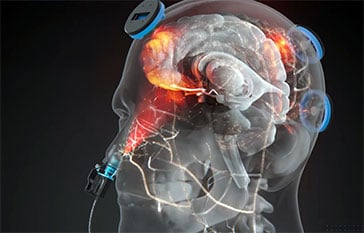
The first observation study used the Vielight Vagus. To understand what it is reaching for, start with the vagus nerve itself. It is the longest of the cranial nerves, running from the brainstem down into the chest and abdomen, and it is the main highway of the parasympathetic nervous system, the rest-and-digest side of the autonomic balance. Most of its fibers are afferent, meaning they carry signals up into the brain rather than down to the organs. Those signals arrive first at a brainstem hub, the nucleus tractus solitarius, and from there fan out to limbic and cortical networks that shape arousal, mood, and attention. Nudge the vagus, and you are not only speaking to the heart and gut, you are speaking upward, to the brain.
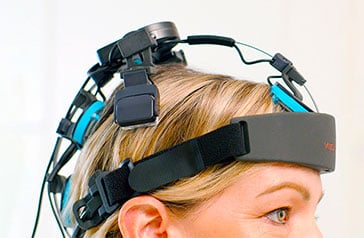
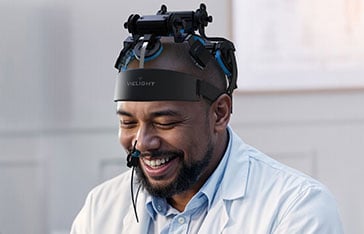
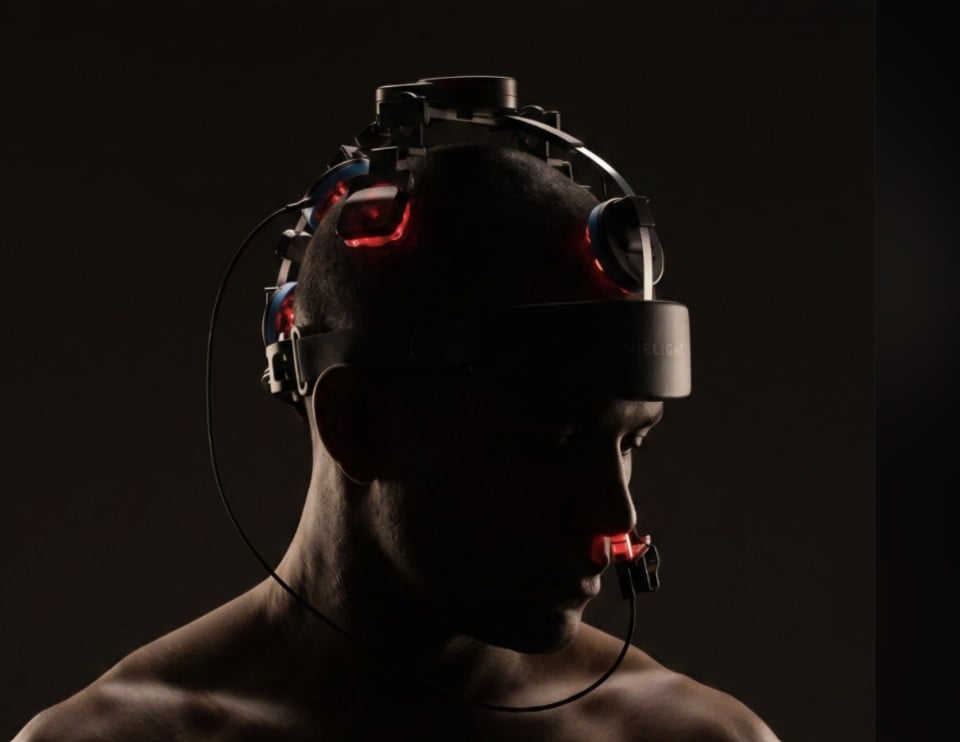
The Vielight Vagus approaches that pathway with light rather than electricity. It delivers 810 nm near-infrared light, pulsed at 100 Hz, through bilateral modules at the neck and an intranasal applicator. The 810 nm wavelength sits in a near-infrared window where light penetrates tissue relatively well and is absorbed by cytochrome c oxidase, a component of the cellular energy machinery, which is the widely proposed basis for photobiomodulation effects. The stated aim is to support brain-body connectivity and parasympathetic tone. Whether light delivered this way meaningfully engages vagal pathways is exactly the kind of question that needs measurement rather than assumption, which is what makes a brain read-out valuable here.
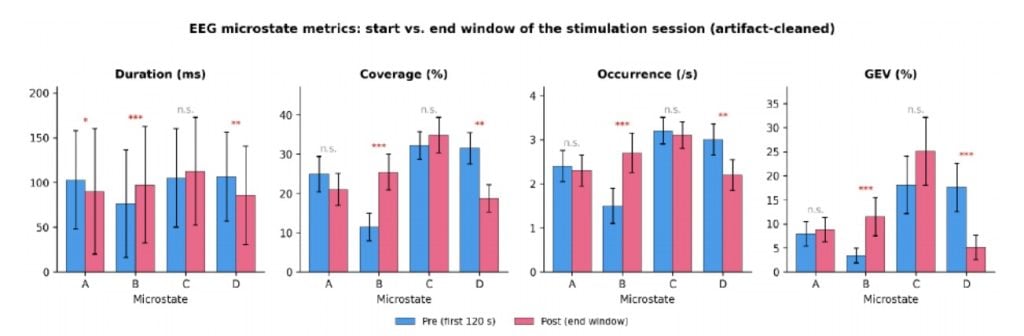
That read-out is where microstates come in. If the device shifts the brain toward a calmer, more parasympathetically-weighted state, that change should leave a trace in how the brain’s resting patterns are organized. Microstates are well suited to catch it: they respond to shifts in vigilance and relaxation, they resolve at the millisecond scale, and they can be tracked continuously across a single session. So the design was direct. Record 19-channel EEG continuously through one 20-minute eyes-closed session, then compare the microstate profile near the end against the profile at the start.
The result was clean and, importantly, coherent. Three changes emerged, and they reinforced one another rather than pointing in scattered directions.
The attention pattern receded, decisively. Microstate D, tied to frontoparietal attention, fell across all four of its measures at once. Its coverage dropped from 31.9% to 18.6%, and the share of signal it explained fell from 15.5% to 4.5%, alongside declines in how often it appeared and how long it held. When a state weakens simultaneously in how often, how long, how much, and how strongly it explains the signal, that is internally consistent evidence of a real withdrawal, not noise in a single number.
The visual-network pattern rose, as a near mirror image. Microstate B climbed across the same four measures, its coverage roughly doubling from 11.8% to 24.8% and its explained-signal share rising from 3.6% to 11.5%. Because the eyes stayed closed the whole time, this cannot be a response to anything the person was looking at. It reflects the brain’s own internal dynamics reorganizing.
The transitions told the same story. The moment-to-moment sequence was pulled toward microstate B from every other state and away from microstate D, a whole-structure shift that matched the per-measure picture exactly. Across three independent analytic views, the recording told one story: a firm withdrawal of the outward, vigilant attention pattern in favor of a quieter, more internally-directed configuration. That is the direction one would expect a parasympathetically-oriented session to produce, and here it showed up plainly.
One detail deserves emphasis, because it is a mark of rigor rather than a footnote. When the researchers first analyzed the raw, uncleaned recording, the microstate B effect actually pointed the opposite way. Only after proper artifact rejection did the coherent pattern above emerge. Rather than bury that, the report documents it, a concrete demonstration that short within-session microstate comparisons are highly sensitive to artifact and that disciplined cleaning is not optional. It is the kind of transparency that makes the cleaned result more trustworthy, not less.
Device two: 40 Hz gamma stimulation
The second observation study used the Vielight Neuro Gamma, which delivers 810 nm light pulsed at 40 Hz, transcranially and intranasally. Forty hertz is the gamma frequency associated with cognitive engagement and attention, and that is the territory this device is designed around. Here the recording ran across three phases: a baseline, five minutes of active stimulation, and a post-stimulation rest.
The clearest observation ran in the opposite direction to the Vagus recording. At baseline, this person’s attention-associated microstate D was unusually weak compared to age-matched norms. During active stimulation, microstate D moved back up toward the normal range, and a previously suppressed transition into that attention state reversed. Rather than stepping away from the attention pattern, this session appeared to bring an underexpressed attention pattern back toward typical values, which loosely rhymes with a cognition-focused, engagement-oriented design.
A note on the gamma observation. The during-stimulation shift toward normative microstate D is the most robust finding in this recording. The post-stimulation portion showed additional changes, but that segment carried a large amplitude anomaly and required artifact correction that the authors caution may itself affect the results, so we do not lean on it here. This report is a working draft, and the findings should be read as provisional.
 Figure 2.Vielight Neuro Gamma session: a below-normative microstate D shifts toward the normal range during active stimulation. Exploratory single-case observation (draft).
Why two different directions is the interesting part
It would be easy to assume that any light-based session, done sitting quietly with eyes closed, should nudge the brain the same generic way. If that were the whole story, both recordings would drift in the same direction, toward a single settling pattern. They did not. One session saw the attention pattern step back; the other saw it move forward.
That divergence is what makes these worth reporting together. Two devices, running at different pulse frequencies, on different targets, left different signatures on the same measure. And each shift pointed in the general direction of what its device was built for: a calm-oriented device associated with a quieter pattern, a cognition-oriented device associated with an attention pattern moving toward normal. Two fingerprints, each rhyming with its design.
Vagus · 100 Hz
Attention pattern steps back
Microstate D down, B up. A quieter, more inward configuration, in the territory of a calm-oriented design.
Gamma · 40 Hz
Attention pattern moves toward normal
A below-normal microstate D rises toward typical values during stimulation, in the territory of a cognition-oriented design.
What this does and does not show
These are two separate single-person observations, each without a sham or control condition. That means neither can separate a stimulation effect from ordinary factors such as relaxing over time, drifting toward drowsiness, or the natural variability of one brain on one day. The two recordings also used different devices and different designs, so they are not strictly comparable, and the divergence could equally reflect two unrelated individual quirks rather than a device-specific pattern.
So the honest reading is modest and, we think, genuinely intriguing. The value here is not proof of any effect. It is that a single sensitive brain measure detected coherent, and notably different, reorganizations around two different kinds of stimulation, each in the general direction of its design. That is a specific, testable idea, and the natural next step is the same in both cases: controlled, sham-based studies that can tell a real signature from a coincidence.
Disclaimer. Vielight devices are general wellness products and are not intended to diagnose, treat, cure, or prevent any disease or medical condition. The observations described here are preliminary, single-case, uncontrolled, and in one instance drawn from a working draft. They do not demonstrate clinical efficacy, cognitive benefit, or a specific mechanism of action, and any resemblance between an observed brain-state shift and a device’s intended purpose is descriptive only, not an established effect. Individual results may vary. This content is provided for general educational and informational purposes only.


