












Vielight Neuro vs PBM Helmets | The Engineering Advantage
As the original inventors of home-use brain photobiomodulation technology in 2014, we learned that effective brain photobiomodulation is difficult. Delivering the optimal amount of light energy into the brain in a safe and effective manner takes considerable research and engineering.
Here are the reasons behind the Neuro’s unique patented design.
- The problems with standard PBM helmets
- The engineering behind the Vielight Neuro
- Full transcranial coverage with few highly-engineered Vie-LEDs
- Published clinical research and irradiance comparisons
- 810nm vs 1064 nm / 1070nm

The Problems with tPBM Helmets
Standalone transcranial photobiomodulation (tPBM) helmets are not optimized for brain photobiomodulation.
Hair as a barrier
The inflexible dome-shape of PBM helmets does not part hair, causing maximal loss through hair absorption.
Helmets are inflexible
Because they are inflexible, they can’t accommodate variations in head sizes and shapes well, introducing distance and rapid energy loss through the inverse square law of light.
Helmets often use many weak, inefficient LEDs
A helmet-only PBM penetration study by the Faculty of Medicine, Ludwig-Maximilians-University (LMU) indicated that a transcranial-only helmet (256 LEDs, 1070nm wavelength) was unable to penetrate the skull and effect mitochondria in an effective manner.
tPBM is incomplete vs itPBM
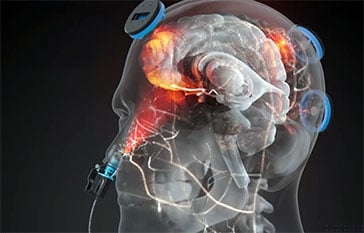
Transcranial PBM (tPBM) only reaches the top-side of the brain. It doesn’t reach deeper subcortical brain structures like intranscranial-transcranial PBM (itPBM) does.
The Vielight Neuro | Solving “Helmet” Problems
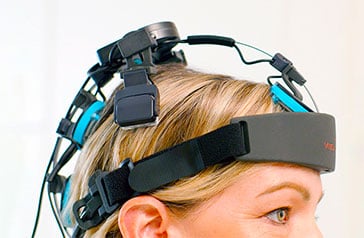
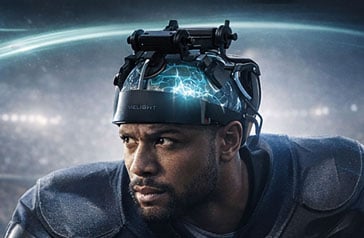
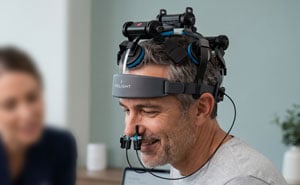
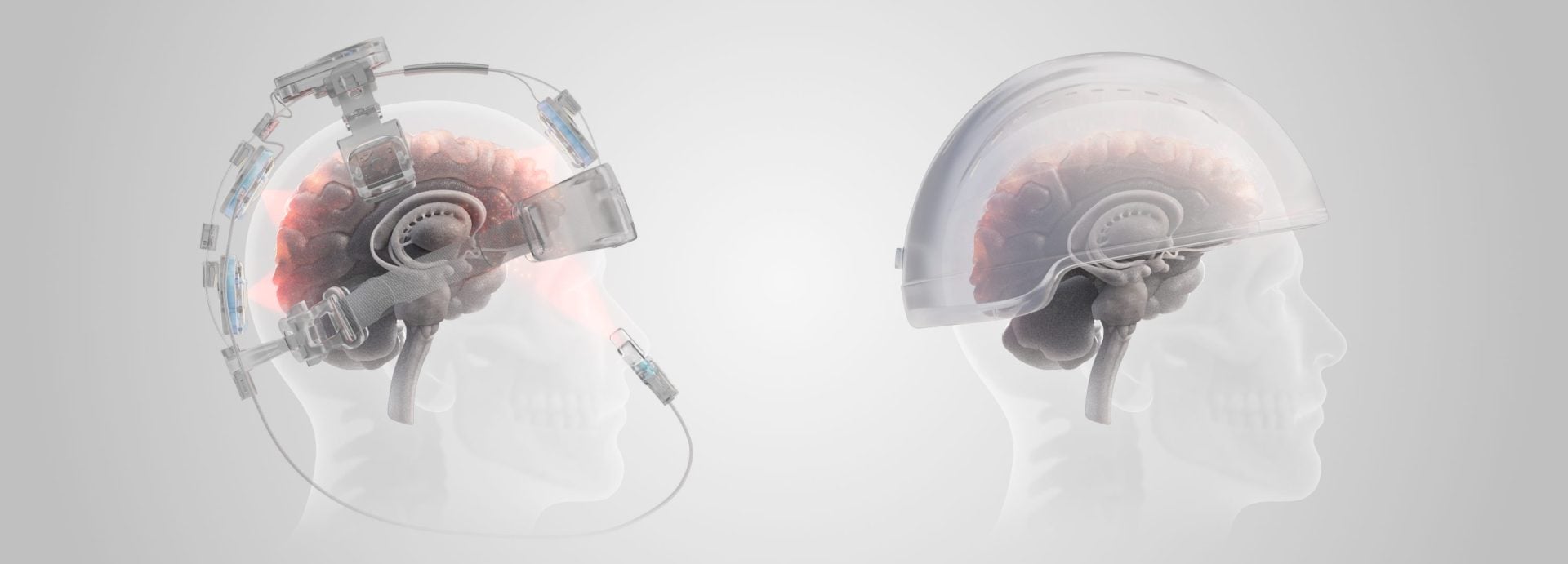
The Vielight Neuro’s is a next-generation near-infrared helmet with a unique patented intranasal-transcranial (itPBM) design with the highest-measured full-transcranial irradiance.
The combined intranasal-transcranial technology approach enables NIR energy to be delivered to cortical and ventral brain structures.
A study by Baycrest Hospital with Vielight technology has shown the intranasal method to be 20x more effective than transcranial-only method and allows light energy to reach deep brain subcortical structures.
Vielight itPBM vs tPBM | Full-Brain Coverage vs Half

Why the Vielight Neuro is a Next-Generation Brain PBM Device
| Problem | Vielight Solution |
Note: Irradiance, not total power, determines whether photons reach cortical tissue with sufficient energy to activate cytochrome c oxidase (CCO) in cortical tissue. |
Note: The DMN is disrupted in Alzheimer’s disease and traumatic brain injury – making it the most critical target in brain photobiomodulation. |
|
|
|
|
Next-Generation Architecture vs. Legacy LED Helmets
The Myth of LED Density: Why 5 or 100 is Greater Than 100
In the early stages of brain photobiomodulation (PBM), the industry standard was the “total-surface helmet” – a device utilizing hundreds of low-power LEDs to cover the entire scalp. While visually impressive, this Old-Generation architecture often fails the most critical test of physics: transcranial penetration.
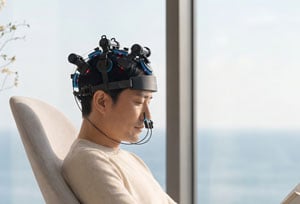
The Vielight Neuro represents a Next-Generation modular design. Instead of broad, low-irradiance coverage, the Neuro utilizes 5 (Neuro Alpha/Gamma) or 10 (Neuro Pro) high-fluence Vie-LED modules strategically positioned to target the Default Mode Network (DMN).
Photonic Scattering & The “Halo Effect”
The secret to the Neuro’s efficiency lies in Optical Diffusion (Photonic Scattering).
-
Volumetric Saturation: When high-fluence 810nm photons (300–400 mW/cm²) hit the skull, they don’t just travel in a straight line. They scatter, creating “energy halos” that expand as they move through the bone and into the cortex.
-
The Fill Factor: This scattering causes the energy from the 5 or 10 modules to overlap deep within the brain tissue. This creates a seamless volumetric footprint that saturates the DMN—including deep hub nodes like the precuneus and posterior cingulate cortex—more effectively than a 200-LED helmet that lacks the irradiance to push photons past the initial bone barrier.
By focusing on irradiance over quantity, the Vielight Neuro achieves full transcranial efficiency with a fraction of the hardware, ensuring that the target neurons actually receive the threshold of energy required for a biological response.

Watch: The Vielight Next-Gen Transcranial Energy Footprint
This real-time demonstration reveals the “Halo Effect” of the Vielight Neuro. Notice how 810nm photons scatter through the real human skull, creating a deep-tissue “fill factor” that ensures full transcranial coverage of the Default Mode Network (DMN) using a high-fluence modular design. This illustrates why the Neuro’s 5-10 module configuration outperforms high-density, low-power LED helmets in actual brain-energy delivery.
The Vielight Advantage | Intranasal-Transcranial vs Transcranial
The intranasal channel sits just beneath the cribriform plate, one of the thinnest regions of the human skull (around 0.1 mm). This means that targeted wavelengths, such as near-infrared light, can bypass many of the barriers that limit transcranial penetration, delivering energy more effectively to deep brain structures and circulating blood.
This coverage advantage has led Vielight’s intranasal-transcranial PBM (itPBM) approach to lead the industry in number of published clinical studies.

Supported by Science (The Research Advantage)
Vielight technology is featured in the most published research in the field of brain photobiomodulation by a significant margin and has the deepest penetration in the entire industry.
We understand the need to validate the engineering theory behind our devices with scientific data. A simple idea like placing LEDs on your head can turn surprisingly complex when taking different parameters into account, like the pulse rate, wavelength and power density to maximize efficacy.
Other devices cannot easily emulate our efficacy because of our proprietary Vie-LED technology, intranasal and design patents. Brain photobiomodulation is parameter-specific and our Vie-LED technology generates a unique laser-like profile and an industry-leading irradiance on specific and important brain networks, like the Default Mode Network.
The table below is a benchmark studies published comparison against random PBM helmets.
| Technology | Form Factor | Research | Manufacturer | Medical Device Licenses |
|---|---|---|---|---|
| Vielight Neuro (Vielight) | Modular | 27 published (17 ongoing) | Vielight, Canada | 3 |
| Weber Medical LED Infrared Helmet | Helmet | 0 published | Suyzeko, China (Private-labelled) | – |
| Neuradiant 1070 (Neuronic) | Helmet | 3 published | Suyzeko, China (Private-labelled) | – |
| Suyzeko PBM Helmet (Suyzeko) | Helmet | 1 published | Suyzeko, China | – |
*Data as of Sept 2025
Don't Be Fooled by "Total Power" (mW)
Many PBM helmets advertise high total power (mW) by adding up the output of many LEDs. That figure can sound impressive, but it doesn’t tell you how much light actually lands on the scalp in a useful way.
-
Total power (mW) is like a floodlight: a large amount of light, spread over a wide area.
-
Irradiance (mW/cm²) is like a laser: the light is concentrated—so the intensity at the surface is higher.
Here’s an example: 1 mW x 10,000 LEDs = 10,000 mW total power output but just 1 mW/cm2 of irradiance, or just 1/30 of the irradiance of the NIR spectrum of sunlight.
Vielight devices are designed to deliver high irradiance at specific contact points (≈250 mW/cm²), enabling light to couple into tissue effectively and disperse through the underlying structures, rather than being weakened by hair, distance, and poor fit.
The depth of penetration and the stimulation of mitochondrial chromophores like cytochrome c oxidase depend on a sufficient irradiance threshold at the tissue interface. If the irradiance is too low, especially at the scalp, the photons do not reach deeper cortical or subcortical targets effectively, even if total emitted power is high.
More LEDs with lower irradiance increase coverage but do not compensate for low penetration. This limitation, they may increase coverage, but they do not enhance penetration unless irradiance per diode is sufficiently high.

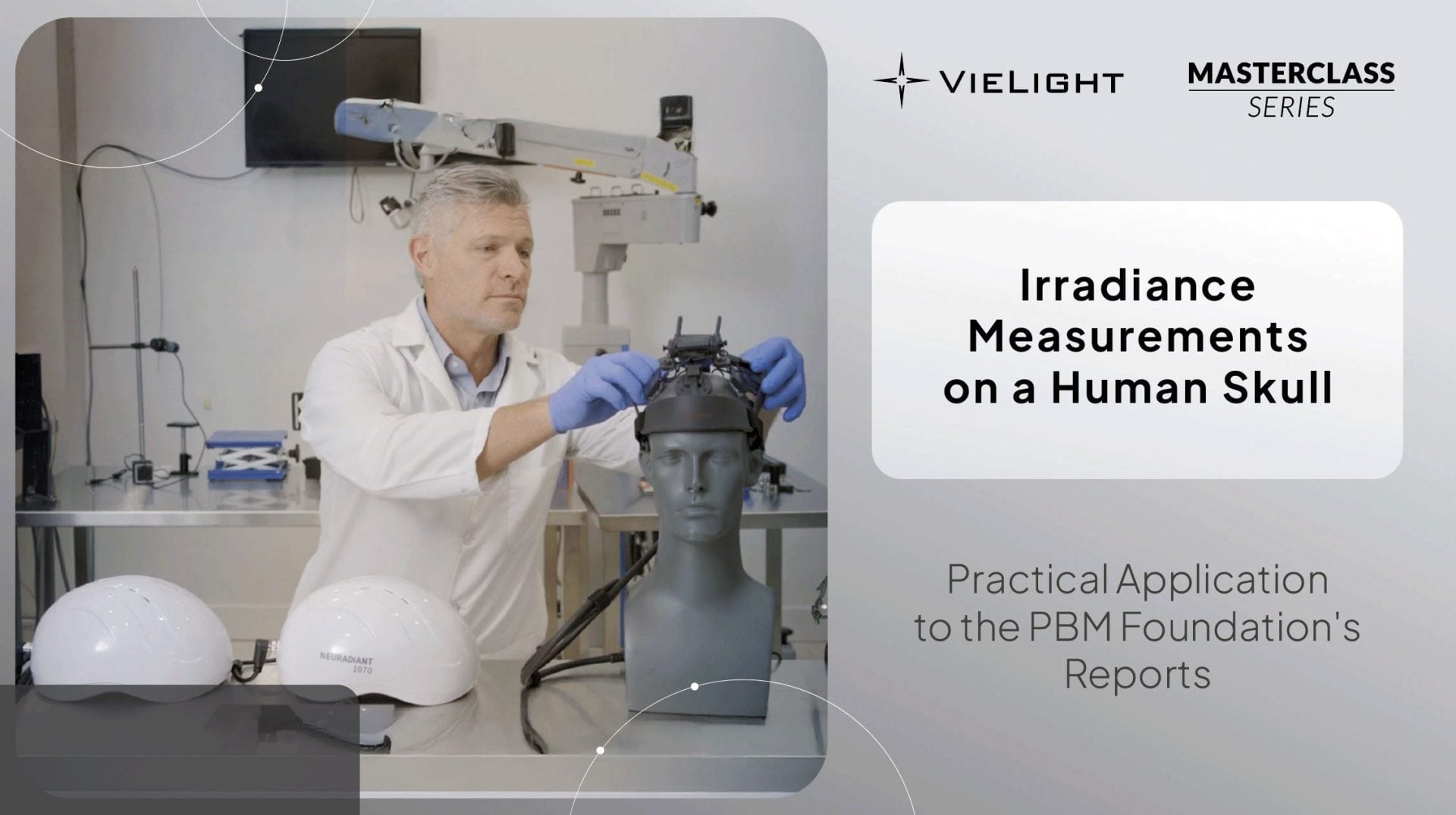
Independent irradiance results from the PBM Foundation and Optonic Lab (part of Solar Light now)
The Vie-LED Irradiance Advantage
Vie-LED technology is unique and is engineered to generate a laser-like irradiance profile but with the safety of LEDs.
The PBM Foundation benchmarked the Vielight Neuro against two PBM helmets, the Suyzeko NIR helmet and Neuronic Neuradiant twice, as case studies for their testing program to standardize irradiance reporting.
MegaLab and Optronic Lab, photonics engineering firms, conducted the tests:
- Read the full independent test report from Optronic Lab here.
- Read the full independent test report from MegaLab here.
A 2024 systematic review that screened 2,133 records and included 97 brain PBM studies reports that irradiance (power density) was typically ~250 mW/cm². The Vielight Neuro with an independently measured irradiance of 180-333 mW/cm², is mostly inline with the irradiance used in these studies, which included lasers. However, the Neuronic and Suzyeko helmets generated less than 5% of the average irradiance used over 97 analyzed brain PBM studies.
Irradiance comparison table
| Source | Independently measured irradiance | Manufacturer | % of Typical Brain-PBM Irradiance (≈250 mW/cm²) |
|---|---|---|---|
| Vielight Neuro (Vielight) | 180-350 mW/cm2 | Vielight, Canada | 80–160% |
| Neuradiant 1070 (Neuronic) | ≈9 mW/cm2 | Suyzeko, China (Private-labelled) | ≈4% |
| Suyzeko PBM Helmet (Suyzeko) | 5 mW/cm2 | Suyzeko, China | 3% |
| Natural Sunlight | 100 mW/cm2 | Free | 40% |
*Data based on published data by the PBM Foundation in coordination with Optronic Lab and Megalab.
“The Vielight Neuro generated 20-30x more irradiance than the tested PBM helmets, aligning it with the power density levels used in successful clinical research.” — Based on PBM Foundation Standardized Testing.
Dr Cody Rall | Vielight vs Neuronic (Standard Helmet)

Dr Cody Rall | US Navy Psychiatrist | Vielight Neuro Comparison Tests
While the PBM Foundation’s standardized reports provide the data-driven proof of our irradiance levels, independent reviewers like Cody Rall (Techforpsych) have provided the visual proof. In his ‘Skull Test,’ he demonstrated that the Vielight Neuro delivered significantly more light energy through the skull than traditional helmets, which often failed to penetrate the bone at all.
“The 3-Second Advantage” Comparison Table
| Feature | Generic PBM Helmets | Vielight Neuro (Next-Gen) |
| Penetration | 5–9 mW/cm² (Weak) | 180–350 mW/cm² (Research-Grade) |
| Brain Coverage | Scalp only (Dorsal) | Total (Dorsal + Ventral/Underside) |
| Deep Access | Blocked by skull | Intranasal (Cribriform Plate Path) |
| Thermal Mgmt. | Closed dome (Traps heat) | Modular (Air-cooled & Adjustable) |
| Evidence | Zero to 3 studies | 25+ Published Clinical Trials |
Medical Device Standards
Vielight is one of the few North American photobiomodulation manufacturers fully certified as a medical device company (ISO 13485, MDSAP, and MDR). Our technology is FDA and Health Canada registered.
Light-Based Terminology
- Power density (mW/cm2)
Power density is the amount of light energy emitted directly from the source.
Power density can be hindered by distance and hair and is not an accurate indication.
- Irradiance (mW/cm2)
Irradiance is the amount of light energy landed on a surface from the source.
While surface radiant power density and radiant power density share the same measurement unit mW/cm2, they are not equivalent.
Surface radiant power density gives an accurate picture of how much energy the scalp receives.
- Total power
Total power is defined as the total amount of energy emitted over a period of time by all light sources.
Many weak inefficient LEDs can generate a high total power but if the surface radiant power density is too low and if blocked by hair, light energy won’t penetrate the skull.


