
 Shop Vielight tech














Brain Photobiomodulation Pathways: What the Latest Research Shows
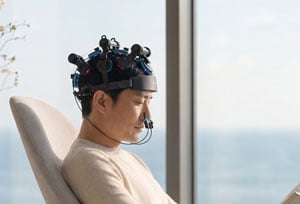
Many people picture brain photobiomodulation (PBM) as one simple thing: near-infrared light passes through the skull and gives brain cells more energy. That picture is only part of the story.
Research published with Vielight technology through 2026 points to three distinct pathways. Light supports energy production inside brain cells. Pulsed light interacts with the brain’s natural rhythms. And the route the light takes (through the skull, through the nasal cavity, or both) shapes which brain regions it can reach.
This article was first published in October 2022. It has been updated in October 2026 with findings from the 30+ published studies conducted with Vielight technology at 20+ research institutions, including the University of Toronto, the University of Utah, Baycrest Health Sciences and the University of Sydney.
Vielight devices are general wellness products. They are not intended to diagnose, treat, cure, mitigate or prevent any disease. This article summarizes published research for educational purposes. Full disclaimer at the end.
The three pathways at a glance
Each pathway answers a different question: what light does inside a cell, how pulsing changes brain activity, and where the light actually goes.
| Pathway | What happens | Latest evidence with Vielight technology |
|---|---|---|
| 1. Cellular energy | Near-infrared light is absorbed by an enzyme in mitochondria (cytochrome c oxidase), a step linked to more ATP, the cell’s energy molecule | 2026 University of Toronto trial: a blood marker of cell energy shifted toward mitochondrial energy production with the active device, and away from it with sham |
| 2. Brain rhythms | Light pulsed at a brainwave frequency, such as 10 Hz (alpha) or 40 Hz (gamma), can shift electrical activity across the brain | EEG studies recorded changes in alpha, beta and gamma activity and in network connectivity after pulsed itPBM |
| 3. Delivery route | Light through the skull reaches the outer cortex. Light from inside the nasal cavity adds a route toward deeper structures | 2026 Baycrest fMRI study: intranasal PBM was followed by measurable responses in the thalamus, a deep relay hub, which an earlier forehead-only study did not show |
The sections below take each pathway in turn, then summarize the newest published results and the studies now underway.
Pathway 1: cellular energy
The best-studied pathway starts inside mitochondria, the power plants of every cell. Near-infrared light at wavelengths such as 810 nm is absorbed by cytochrome c oxidase, an enzyme in the mitochondrial energy chain. Researchers think the light frees this enzyme from nitric oxide, which lets energy production run more freely and raises output of ATP (de Freitas & Hamblin, 2016).

This step also sends brief signals through the cell, including small bursts of reactive oxygen species and calcium. These signals activate transcription factors that drive longer-lasting changes in the cell, which helps explain why effects can outlast a session. Lab studies using 810 nm light pulsed at 10 Hz, including one with a Vielight Neuro Alpha 2, have also observed changes in tubulin, the protein that builds a neuron’s internal scaffolding (Staelens et al., 2022; Di Gregorio et al., 2024).
New: the first human evidence from a Vielight trial
Until recently, most evidence for this pathway came from cells and animals. A 2026 randomized, sham-controlled trial at St. Michael’s Hospital and the University of Toronto measured it in people (Rashidi-Ranjbar et al., 2026, Journal of Alzheimer’s Disease). Twenty adults aged 60 to 85 with mild cognitive impairment used a Vielight Neuro (810 nm, pulsed at 40 Hz) or an identical sham device at home for 20 minutes, six days a week, for six weeks.
| Blood marker | What it reflects | Result after six weeks |
|---|---|---|
| Lactate-to-pyruvate ratio | How cells make energy. A lower ratio points to more efficient, oxygen-based energy production in mitochondria | Fell with the active device and rose with sham (p = 0.0077), one of the largest effects in the trial |
| L-carnitine (exploratory) | Helps carry fuel into mitochondria | Rose with the active device |
| IL-6 (exploratory) | An immune signaling protein linked to inflammation | Fell with the active device |
The authors read the main result as a shift toward mitochondrial energy production, the process near-infrared light is thought to act on. The markers were measured in blood rather than inside the brain, and this was a 20-person pilot, so larger trials are needed to confirm it. Read our full summary of the trial.
Pathway 2: brain rhythms
Brain cells fire together in rhythms, which EEG records as brainwaves. Alpha waves (around 10 Hz) are linked to relaxed wakefulness. Gamma waves (around 40 Hz) are linked to focused attention and memory processing. Pulsing near-infrared light at one of these rates adds a second pathway on top of the cellular one.
Two animal studies first pointed to frequency mattering. In mice with brain injuries, the same dose of near-infrared light pulsed at 10 Hz led to better results on cognitive tests than continuous light or 100 Hz pulsing (Ando et al., 2011). At MIT, 40 Hz flickering light lowered amyloid beta, a protein that builds up in Alzheimer’s disease, in mice bred to model the disease (Iaccarino et al., 2016). That study used visible flicker rather than near-infrared PBM, but it sparked wide interest in 40 Hz stimulation.
What EEG studies with Vielight technology show
Human EEG research now shows that pulsed itPBM does more than nudge one brainwave. It can shift activity across the whole frequency spectrum.
| Study | Participants | Pulse rate | What was observed |
|---|---|---|---|
| Garner & Feiner, 2026 (exploratory observations) | 2 single cases | 100 Hz (Vielight Vagus) and 40 Hz (Vielight Neuro Gamma) | Each device left a different EEG microstate fingerprint. With the Vagus, an attention pattern stepped back in favor of a quieter one. With the Neuro Gamma, a below-normal attention pattern moved toward the normal range during stimulation |
| Randomized sham-controlled crossover study, 2021 (Brain Stimulation, abstract) | 25 healthy adults | 10 Hz | Theta, alpha, beta and gamma activity changed after active stimulation. Intranasal light on its own raised beta and gamma activity |
| Zomorrodi et al., 2019 (Scientific Reports) | 20 healthy adults | 40 Hz | A single session raised faster brainwaves (alpha, beta, gamma), lowered slower ones (delta, theta) and changed network connectivity, compared with sham |
The 2026 observations were single-person recordings without a sham condition, so they are early signals for controlled studies to test. The bigger open question is which frequency suits which goal. Vielight is now running an EEG study at its Toronto headquarters to map brain responses to the Neuro Pro 2 across a range of pulse frequencies.
Pathway 3: the delivery route
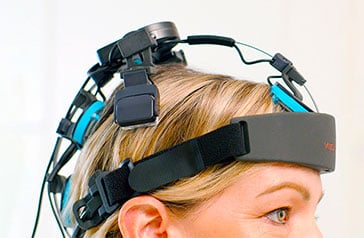
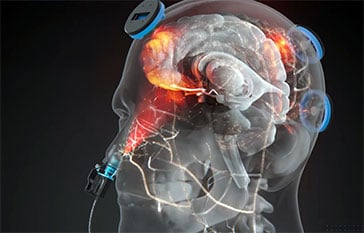
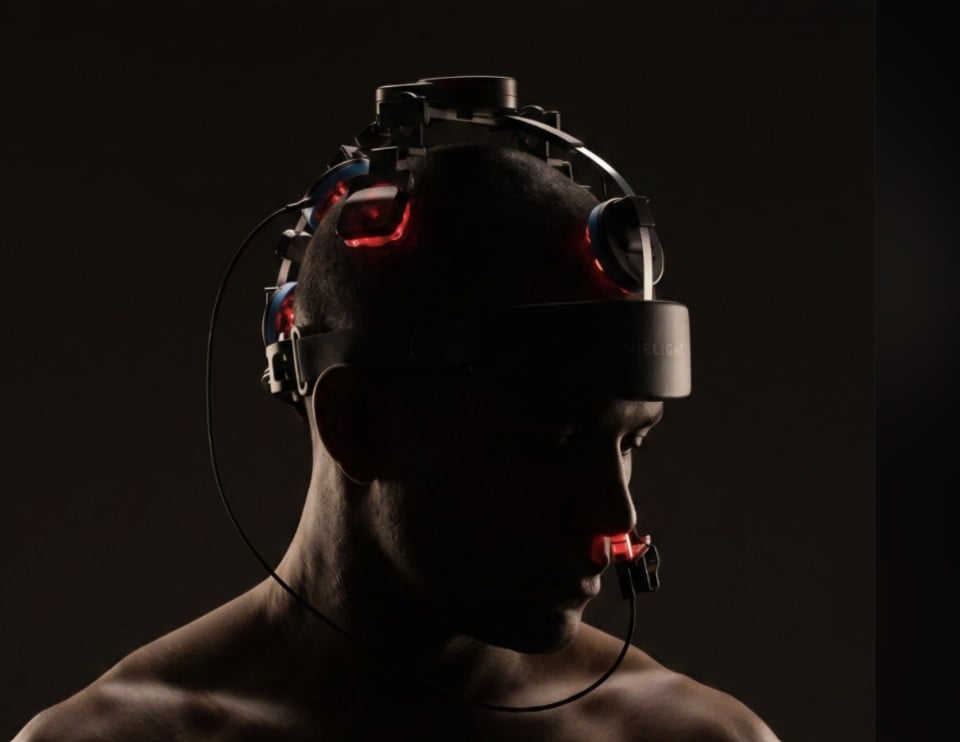
Where light enters decides where it can act. Vielight Neuro devices use two routes at once, which is why the approach is called intranasal-transcranial PBM (itPBM).
| Route | What it reaches | Latest evidence |
|---|---|---|
| Transcranial (scalp LEDs) | The outer cortex, including the hubs of the default mode network | 2026 Toronto trial: default mode network connectivity rose with the active device and fell with sham (p = 0.014) |
| Intranasal (nasal LED) | The underside of the brain through the thin, porous bone above the nasal cavity, with responses recorded in deep structures | 2026 Baycrest fMRI study: the thalamus, amygdala, hippocampus and hypothalamus responded |
The scalp route and the default mode network
The default mode network links brain regions that work together when you rest, recall the past and reflect. Its hubs include the medial prefrontal cortex, the posterior cingulate cortex, the precuneus and the inferior parietal lobes. It is one of the most studied networks in memory research and one of the first to change in Alzheimer’s disease, which makes it a major research target.
The scalp LEDs on Vielight Neuro devices sit over these hubs. Three studies have now measured what happens there:
- In the 2026 University of Toronto trial in adults with mild cognitive impairment, network connectivity rose with the active device and fell with sham, a large effect (effect size 1.25) (Rashidi-Ranjbar et al., 2026).
- In a University of California San Francisco pilot, 8 people with dementia who used a Vielight Neuro at home for 12 weeks showed higher default mode network connectivity and brain blood flow on MRI (Chao, 2019).
- In 58 healthy adults, a single 20-minute itPBM session over the default mode network was followed by higher divergent-thinking (idea generation) scores than sham (Peña et al., 2024).
The nasal route and the deep brain
Deep brain structures are hard to reach from outside the skull, because skin, hair and thick bone scatter most of the light. The nasal cavity offers a shortcut. At its top sits the cribriform plate, a thin, porous bone directly beneath the brain.
In 2026, researchers at Baycrest’s Rotman Research Institute and the University of Toronto tested the nasal route on its own for the first time with brain imaging (Van Lankveld et al., 2026). Forty-five healthy adults received near-infrared light through one nostril during fMRI scans.
| Finding | Result |
|---|---|
| Deep brain response | The thalamus, amygdala, hippocampus and hypothalamus responded. The same team’s earlier forehead-light study found no deep response |
| Efficiency | Per unit of light, the nasal route produced about 28 times more brain response than forehead light |
| Light level | 5 to 9 mW/cm², low enough that the authors rule out heating effects |
| Timing | In several regions the response kept rising after the light switched off |
A second Baycrest preprint measured brainwaves during nasal light alone and found a strong EEG response, similar to forehead light, using a small fraction of the energy (Mathew et al., 2026). Both are preprints that have not yet completed peer review, and both used research lasers supplied by Vielight rather than consumer devices. Read our full summary.
Together, the two routes cover more of the brain than either alone: the scalp LEDs reach the cortical hubs of the default mode network, and the nasal LED adds a route toward the deep structures beneath them.
Latest findings, 2025 to 2026
Since this article first appeared, researchers have published a wave of new studies with Vielight technology, including four randomized, sham-controlled trials in 2026 alone. The table lists the key results, newest first.
| Year | Study | Participants and design | Key result |
|---|---|---|---|
| 2026 | Rashidi-Ranjbar et al., Journal of Alzheimer’s Disease (University of Toronto, St. Michael’s Hospital) | 20 adults aged 60 to 85 with mild cognitive impairment. Randomized, sham-controlled, 6 weeks of home use | Memory scores rose with the active device and slipped with sham (MMSE +1.0 vs −0.5, p = 0.035). Cell-energy and brain-network results also favored the active group |
| 2026 | Peña et al., Journal of Creative Behavior (University of Deusto) | 56 healthy adults. Randomized, double-blind, sham-controlled, one 20-minute session over the prefrontal cortex | Higher scores than sham on a word-association problem-solving test (p = 0.016) and on the Stroop attention test (p = 0.031) |
| 2026 | Van Lankveld et al., bioRxiv preprint (Baycrest, University of Toronto) | 45 healthy adults. fMRI during nasal light only | The thalamus, amygdala, hippocampus and hypothalamus responded, with about 28 times more response per unit of light than forehead light |
| 2026 | Lindsey et al., Journal of Neurotrauma (University of Utah, BYU) | 26 NCAA Division I football players. Randomized, double-blind, sham-controlled, one 16-week season | Two MRI markers of white matter rose across the sham group’s brains (large effects) and held largely steady in the active group |
| 2026 | Lim et al., eClinicalMedicine | 43 adults with long COVID. Randomized, double-blind, sham-controlled, 8 weeks of home use | In participants under 45, overall cognitive scores improved more than with sham (p = 0.028). Visual attention showed the most consistent gains. No serious adverse events |
| 2025 | Motsenyat et al., Brain Stimulation (Baycrest, University of Toronto) | 45 healthy adults. MRI during forehead or nasal light | Cerebrospinal fluid signals shifted in real time while the light was on. Nasal light matched forehead light at about one-twentieth the power density |
Academic teams designed and ran these studies, and Vielight supplied the devices or research lasers. Most are small or early-stage, so their results are signals for the larger trials now underway. Browse every published study.
What’s next
The next wave of research is larger and more targeted. The biggest is a 300-participant trial funded by a $4.6 million US Department of Defense grant to the University of Utah and NYU, pairing itPBM with computerized cognitive training (University of Utah).
| Study | Participants | Partners | Status |
|---|---|---|---|
| itPBM plus cognitive training in chronic mild TBI | 300 service members and first responders | University of Utah, NYU (US Department of Defense funding) | In progress |
| Memory changes in adults 50+ (NCT06618807) | 60 adults in Toronto, 12 weeks | University of Toronto, Unity Health Toronto | Recruiting |
| Brain responses across pulse frequencies (EEG) | Healthy adults in Toronto, Neuro Pro 2 | Vielight research team | Recruiting |
| Bipolar depression (NCT07510646) | Up to 40 adults, sham-controlled | Toronto | Recruiting |
| PBM Rise: epilepsy, with an Oura Ring (study site) | Adults with epilepsy, Neuro Pro 2 | Cincinnati, Houston, Miami, Warren | Recruiting |
| Older adults at risk for Alzheimer’s (NCT04018092) | 168 adults aged 65 to 89 | National Institute on Aging, University of Florida, University of Arizona | In progress |
| Moderate-to-severe Alzheimer’s disease (NCT03484143) | 228 adults at 12 sites in Canada and the US | University of Toronto, St. Michael’s Hospital | In progress |
These are investigational studies, and their results will decide what the evidence supports. One theme runs through the newest work: the best setting is not the same for everyone. Both Baycrest studies found that responses depended on wavelength, intensity and the individual, which points toward settings tuned to each person’s brain activity. That is the research direction behind the fully customizable Neuro Pro 2 and the EEG-based Vielight-AI platform.
2022 versus 2026: how the picture changed
| When this article was first published (2022) | Today (2026) | |
|---|---|---|
| Pathways | Two: cellular energy and brain rhythms | Three: cellular energy, brain rhythms and the delivery route |
| Cellular evidence | Mostly from cells and animals | A randomized human trial tracked a blood marker of mitochondrial energy production |
| Brain rhythms | Animal studies and early EEG work | EEG studies across 10, 40 and 100 Hz, and a dedicated study now mapping frequencies |
| Deep brain | Assumed from anatomy | Imaged: nasal light alone produced responses in the thalamus, amygdala, hippocampus and hypothalamus |
| Trial quality | Small pilots and case series | Four randomized, sham-controlled trials published in 2026, and a 300-person trial underway |
The science of brain photobiomodulation is still young, and many questions remain open. But the picture is now far sharper than it was in 2022: light can act on brain cells, brain rhythms and deep brain structures, and the route it takes matters as much as the light itself.
Disclaimer
Vielight devices are general wellness products. They are not intended to diagnose, treat, cure, mitigate or prevent any disease or medical condition, including mild cognitive impairment, Alzheimer’s disease, traumatic brain injury, concussion or chronic traumatic encephalopathy (CTE). Research described here is preliminary and does not establish clinical benefit. Several studies used research lasers rather than Vielight consumer devices, and studies listed as in progress are investigational. Anyone with a health concern should speak with a qualified healthcare professional.
References
- Ando, T., et al. (2011). Comparison of therapeutic effects between pulsed and continuous wave 810-nm wavelength laser irradiation for traumatic brain injury in mice. PLoS ONE. Link
- Chao, L. L. (2019). Effects of home photobiomodulation treatments on cognitive and behavioral function, cerebral perfusion, and resting-state functional connectivity in patients with dementia: a pilot trial. Photobiomodulation, Photomedicine, and Laser Surgery. Link
- de Freitas, L. F., & Hamblin, M. R. (2016). Proposed mechanisms of photobiomodulation or low-level light therapy. IEEE Journal of Selected Topics in Quantum Electronics. Link
- Di Gregorio, E., Staelens, M., Hosseinkhah, N., Karimpoor, M., Liburd, J., Lim, L., Shankar, K., & Tuszyński, J. A. (2024). Raman spectroscopy reveals photobiomodulation-induced α-helix to β-sheet transition in tubulins: potential implications for Alzheimer’s and other neurodegenerative diseases. Nanomaterials, 14(13), 1093. doi:10.3390/nano14131093
- Garner, C., & Feiner, T. (2026). Acute reorganization of resting-state EEG microstate dynamics during a single session of 810 nm pulsed photobiomodulation vagus nerve stimulation (Vielight Vagus). Link
- Garner, C., & Feiner, T. (2026). EEG microstate dynamics following transcranial photobiomodulation with Vielight Gamma (40 Hz). Working draft. doi:10.13140/RG.2.2.35969.01120
- Iaccarino, H. F., et al. (2016). Gamma frequency entrainment attenuates amyloid load and modifies microglia. Nature. Link
- Lim et al. (2026). Photobiomodulation for cognitive dysfunction (brain fog) in post-COVID-19 condition: a randomized double-blind sham-controlled pilot trial. eClinicalMedicine. Link
- Lindsey, H. M., Esopenko, C., Jain, D., et al. (2026). Transcranial photobiomodulation promotes neurological resilience in current collegiate American football players exposed to repetitive head acceleration events. Journal of Neurotrauma. doi:10.1177/08977151251403554
- Mathew, A. A., Van Lankveld, H., Zhong, X. Z., et al. (2026). Intranasal photobiomodulation as an energy-efficient, largely parameter-insensitive alternative to transcranial photobiomodulation. bioRxiv (preprint). Link
- Modulation of cortical oscillations using 10 Hz near-infrared transcranial and intranasal photobiomodulation: a randomized sham-controlled crossover study (2021). Brain Stimulation (abstract). Link
- Motsenyat, A., et al. (2025). Modulating cerebrospinal fluid dynamics using pulsed photobiomodulation. Brain Stimulation. doi:10.1016/j.brs.2025.102988
- Peña, J., Muthalib, M., Beaty, R. E., Sampedro, A., Ibarretxe-Bilbao, N., Zubiaurre-Elorza, L., García-Guerrero, M. A., Cortazar, I., Niso, M., & Ojeda, N. (2024). Enhancement of divergent creative thinking after transcranial near-infrared photobiomodulation over the default mode network. Creativity Research Journal, 36(1), 1-14. doi:10.1080/10400419.2023.2219953
- Peña, J., Muthalib, M., Beaty, R. E., Pérez, I., Sampedro, A., Lucas-Jiménez, O., Ibarretxe-Bilbao, N., & Ojeda, N. (2026). The impact of transcranial photobiomodulation on the bilateral dorsolateral prefrontal cortex in enhancing convergent thinking and Stroop test. The Journal of Creative Behavior, 60(2). doi:10.1002/jocb.70112
- Rashidi-Ranjbar, N., Churchill, N. W., Jerkic, M., et al. (2026). A multimodal evaluation of transcranial photobiomodulation in mild cognitive impairment: cognitive, metabolic, and neuroimaging outcomes of a pilot randomized controlled trial. Journal of Alzheimer’s Disease. doi:10.1177/13872877261453911
- Staelens, M., Di Gregorio, E., Kalra, A. P., Le, H. T., Hosseinkhah, N., Karimpoor, M., Lim, L., & Tuszyński, J. A. (2022). Near-infrared photobiomodulation of living cells, tubulin, and microtubules in vitro. Frontiers in Medical Technology, 4, 871196. Link
- University of Utah Health (2025). Shining new light on treatment for traumatic brain injury. Link
- Van Lankveld, H., Chen, J. X., Zhong, X. Z., & Chen, J. J. (2026). Intranasal photobiomodulation: an energy efficient paradigm for cortical and subcortical stimulation. bioRxiv (preprint). doi:10.64898/2026.03.03.709361
- Zomorrodi, R., Loheswaran, G., Pushparaj, A., & Lim, L. (2019). Pulsed near infrared transcranial and intranasal photobiomodulation significantly modulates neural oscillations: a pilot exploratory study. Scientific Reports. Link


